FRANCOIS KNOETZE
Biography
Francois Knoetze (b. 1989, Cape Town, South Africa) is an artist and filmmaker whose practice moves across sculpture, performance, and video. Working primarily with found and discarded materials, his work explores the complex afterlives of things — mapping the social, political, and economic entanglements that tie people to objects, and objects to systems of power.
Raised in Makhanda, Knoetze grew up observing his grandfather reassemble broken toys, appliances and auction finds. This early exposure to repair culture and reuse continues to underpin a practice deeply invested in material histories and ecological futures. His sculptural works — most notably the life-sized suits composed of waste — function simultaneously as archive, character, and critique: wearable assemblages that haunt the present with visions of techno-capitalist excess and environmental collapse.
Knoetze completed a BFA at Rhodes University (2009) and an MFA at the Michaelis School of Fine Art (2015), where his thesis project Cape Mongo gained international recognition. This five-part performance-film series, charting the journeys of characters made entirely of waste, was shown at the Grahamstown National Arts Festival, LagosPhoto, Wiener Festwochen, and the Design Indaba Global Graduate Programme, among others.
Since then, Knoetze’s practice has grown increasingly collaborative and research-driven. In 2019 he co-founded Lo-Def Film Factory with Amy Louise Wilson — a project rooted in low-budget, high-concept speculative storytelling. Lo-Def’s recent works include Dzata: The Institute for Technological Consciousness, a surreal world-building exercise drawing on African technological imaginaries; The Rock Speaks, a short video exploring the mineral memory of geological forms; The Subterranean Imprint Archive, a VR excavation of algorithmic and archival residues; and Concept Drift, a machinic interactive game tracing the lineage of AI through extractive histories.
Knoetze was a Digital Earth Fellow (2019–2020), during which he produced Core Dump, a sprawling video installation tracing the global circuitry of technological debris across Dakar, Shenzhen, Kinshasa and New York. The work was awarded the SeMA-HANA Media Art Award at the 2023 Seoul Mediacity Biennale and has been widely exhibited as a four-channel installation accompanied by sculptural nodes composed of e-waste and machine parts.
Recent projects include a residency with Johannesburg-based Shade for the Waste Not Want Not exhibition, where he collaborated on a VR film and sculptural costume rooted in the material cultures of Johannesburg’s waste reclaimers.
Across his work, Knoetze builds fractured, poetic systems in which human and non-human actors co-exist: data, refuse, myths, and infrastructures converge to tell layered stories about the postcolonial present. Whether in speculative sculpture, DIY cinema, or public workshops, his work invites us to pay close attention to what — and who — is considered obsolete.
He lives and works in Cape Town.

ARTIST STATEMENT
Core Dump: Kinshasa; Dakar; Shenzen; New York (2018–2019); Four films; 12:42, 12:12, 12:17, 12:47; Courtesy of the artist
Core Dump is a four-part video and sculptural installation that traces the fault lines of a global digital machine—an earth-spanning nervous system stretched to its limits. The title refers to a term in computing: a “core dump” is a memory snapshot captured at the moment of system failure. In this project, that metaphor becomes the lens through which I examine the systemic crashes and deep-set imbalances of our interconnected, techno-capitalist world.
Filmed across Dakar, Kinshasa, Shenzhen, and New York, Core Dump explores the entangled geographies of digital technology—its raw material sources, labor circuits, mythologies, and the residues it leaves behind. My entry point was the digital culture boom on the African continent. While mobile technologies, internet access, and tech start-ups are often celebrated as signs of Africa’s digital “arrival,” I was interested in the uneven terrain that underpins these developments. Access alone does not equal equity; participation does not dismantle inherited asymmetries.
In Dakar, I encountered archival footage of Leopold Sédar Senghor speaking at the 1975 Conference of Developing Countries on Raw Materials—a call to resist extractive trade and toxic dumping. These issues remain urgent. Today, minerals mined in the Congo fuel a digital economy whose waste often returns to the continent in the form of discarded electronics. The notion of digital colonialism—where data, hardware, and software pipelines reproduce colonial logics of extraction and control—is central to this work.
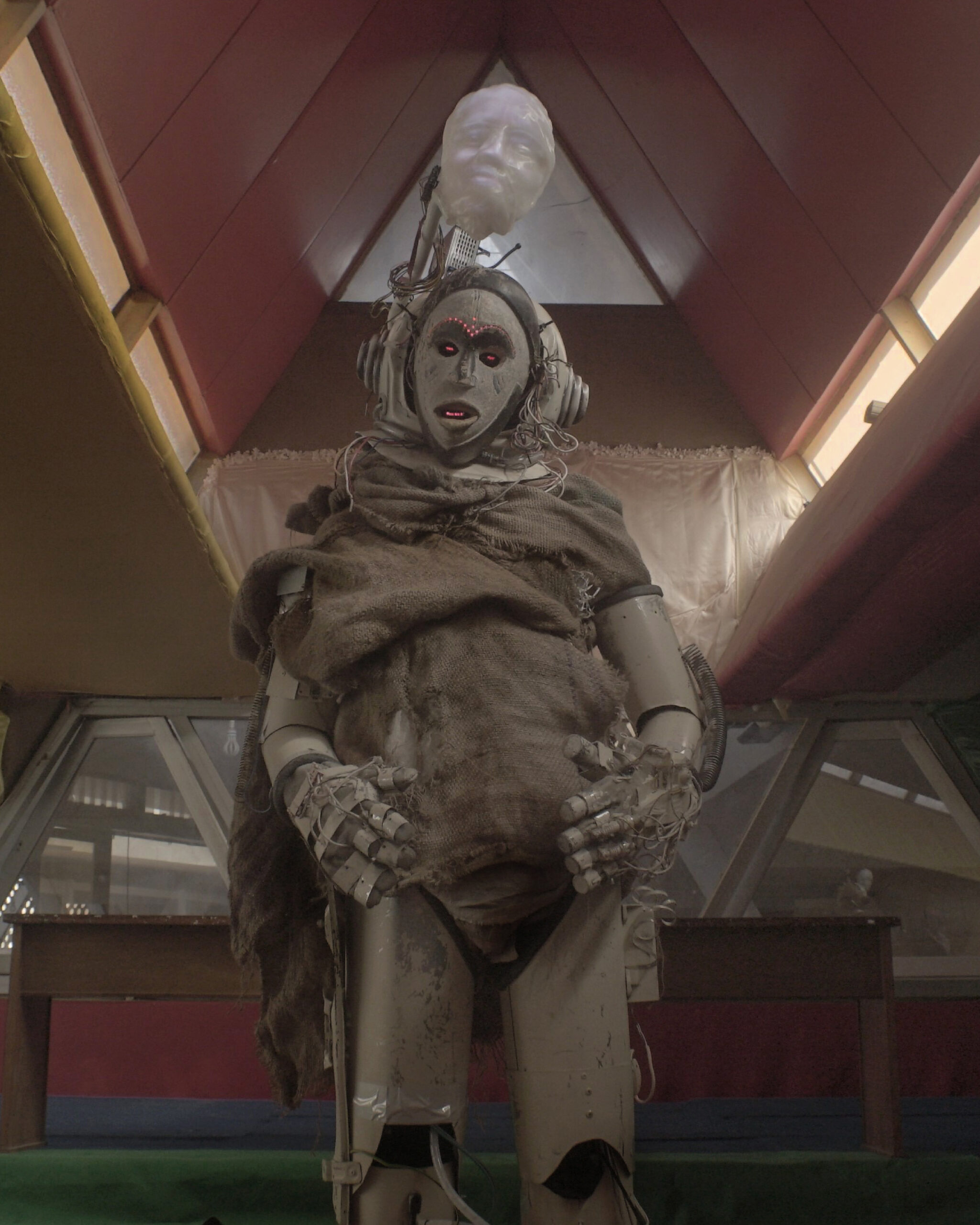
Electronic waste becomes my material: charged artefacts, techno-fossils, residues of an economy that feeds on planned obsolescence. These fragments recall older power formations—plantation economies, imperial trade routes, the human machine of slavery—while pointing to contemporary forms of algorithmic exploitation and environmental violence. In Core Dump, these fragments are reassembled into sculptural nodes and narrative forms that ask: can we debug the present by reading the traces it leaves behind?
The films draw from an expanding archive of found footage, oral myth, and speculative fiction. They build on traditions of resistance and alternative imagining, from the non-aligned and Negritude movements to early pan-African cinema. Ousmane Sembene’s work was especially influential, as were thinkers like Donna Haraway, Gayatri Spivak, Aimé Césaire, and Louis Chude-Sokei—whose writing on Black technopoetics in The Sound of Culture informed the New York chapter of the project.
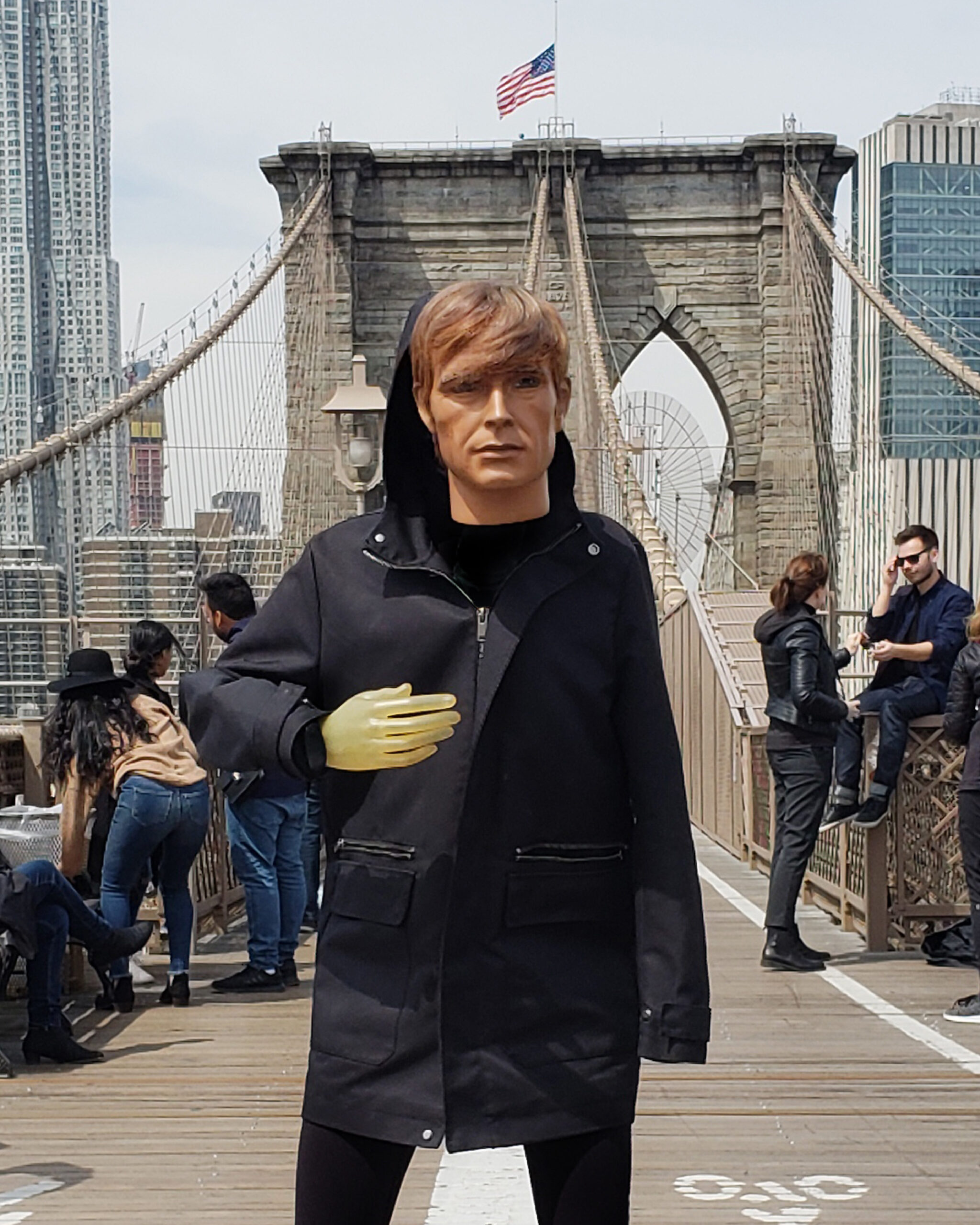
That chapter follows a robot—Boston Dynamics’ “Big Dog”—as it escapes the lab and navigates the hostile terrain of a so-called “smart city.” It ends up discarded on the streets, only to be shipped back to Africa as e-waste. The robot’s journey speaks to techno-mythologies of progress, but also to the entropic feedback loops of capitalist infrastructure.
In Kinshasa, my research drew from the sociologist Joseph Tonda’s concept of “postcolonial imperialism”—a techno-spiritual regime where digitality is grafted onto older structures of domination. Tonda’s recounting of a Congolese urban myth became the seed for an Afro-dystopian horror: a hybrid fiction mapping connections between colonial memory, surveillance, and digitized urban space.
Meanwhile, in Shenzhen—site of the “world’s gadget factory”—I explored the figure of Mami Wata, the West African water deity. A viral internet story claimed she had been captured by Chinese laborers laying fiber-optic cables in the Congo River. I reimagined her in this hyper-industrial landscape, caught between folklore and fiber, as a symbol of hybridity, seduction, and resistance. Mami Wata, in this context, becomes a metaphor for the transmutation of myth under globalization: half-goddess, half-commodity; provider of wealth at a cost.
Across all four cities, Core Dump attempts to map a splintered atlas of the digital age. Not as a seamless space of connectivity, but as a fractured topology of techno-economic asymmetry. The work challenges Western narratives of innovation and progress by highlighting how supposedly “immaterial” systems—cloud storage, data flows, platforms—depend on violently material infrastructures. It suggests that digital modernity is less a rupture than a recursion of extractive histories.
I see Core Dump as a system-wide diagnostic—an imprint of our time, etched in wires, myths, and the bodies of those tasked with holding up the weight of this machine. But the work is also about resistance. About the counter-imaginaries that persist in fragments and stories. About the people who pick through waste, assemble the discarded, and make meaning from the debris of empire.
Ultimately, the series asks whether it is possible to build technological futures that are not predicated on domination. Can we imagine a digital earth animated not by extraction, but by empathy, justice, and repair?


MEET THE ARTISTS