

LEORA FARBER
Biography
With a long history of addressing abjection, embodiment, and domesticity, Leora Farber’s artistic- academic career emulates the concept of practice-based research. Drawing on post-structural and new materialist feminist writing, as well as post-colonial and post-humanist discourses, her interdisciplinary artistic practice includes photography, video art, painting, sculpture, performance art, installation and currently, biological art.[1]
Born in 1964 in Johannesburg, South Africa, Farber began her artistic career by taking art as a subject at high school. Trained as a classical pianist, at the end of high school she was faced with the decision of which to take further: her art practice or her musical practice.[2] After choosing the former, she completed a Bachelor of Art in Fine Art in 1985, majoring in painting, at the University of the Witwatersrand (Wits). She went on to complete her Master of Art in Fine Art in 1992 (Cum Laude) at Wits, under the supervision of South African artist Penny Siopis.[3] In 2013, she graduated with a Doctor of Philosophy in Visual Art from the University of Pretoria.
Throughout her artistic career, Farber has been deeply interested in the body as a site of political intervention. In the paintings she produced for her MA degree and first solo exhibition (1993, Goodman Gallery, Johannesburg) she used plastic and dried versions of objects historically associated with the 17th century Dutch still-life genre. This tradition privileges the gaze – a distanced, disembodied form of looking that involves control and possession and gives authority and power to the viewing I/eye. Farber employed feminist modes of production such as open-endedness and heterogeneity to subvert the privileging of vision over touch and discourage definitive or singular readings of the work.
From 1993-1994, she used similar strategies to represent the female body as a site of rupture and transgression of the patriarchal order. Depicting the rupture of bodily boundaries, she explored ideas of containment and excess. From this preoccupation with the ‘uncontained’ body, she became interested in how bodily excess is contained and controlled within the boundaries of the skin – either through self-imposed regulations such as dieting, exercise and aesthetic surgery or through external mechanisms such as contemporary media representations of cultural ideals.
Her work from 1995-2000 was based on an analogy between fabric and flesh. Working with wax, which bears a strong likeness to human skin, she merged garment and body – corsets with torsos, gloves with hands – allowing distinctions between the inner and outer body to conflate. Skin itself became a site of control, an external ‘fabric’ crafted in ways that mimic the fabrication of ‘femininity’ according to the dictates of the heterosexual, white, male gaze. Sewing implements and beauty aids as well as medical instruments function as primary tools of control. Fastening, piercing or displayed on waxy ‘skins’, these instruments draw parallels between the craft of tailoring a garment to fit a stereotypical body size and contemporary surgical procedures that ‘refashion’ the body to fit western markers of female beauty.
For her practice-led PhD, she produced an extensive exhibition titled Dis-Location/Re-location, that traveled to seven major South African National museums and galleries. The work foregrounded the affective registers used to express lived experiences of displacement by three ‘immigrant’ Jewish women in South Africa spanning spatial and temporal boundaries. Her doctoral dissertation examines each woman’s differing experiences of displacement through the lenses of feminist post-structuralist and post-colonial literature. Underpinning themes include alienation, identity formation and transmutation, hybridity, displacement, adaptation and the construction of white femininity in South Africa.[4]
Since 2017, Farber’s practice has moved into the realm of creative bioresearch (bioart). She began by experimenting with cellulose-fibre produced by the symbiotic action of bacteria and yeast, which feed off a mixture of tea and sugar. During the growth process, a cellulose-based biofilm forms at the air-liquid interface, which, when dried, bears uncanny resemblance to traces of sloughed off human skin. Farber developed an innovative way of making casts of domestic objects using the dried ‘skins’ as a sculptural material, after which she would delineate patterns onto the skins, using painting, printing and drawing techniques.
Experimentation with the biofibre prompted a curiosity to see what further work could be done using bacteria as media. In 2019, she approached Prof Tobias Barnard (Director, Water and Health Research Centre, Faculty of Health Sciences, at the University of Johannesburg), who introduced her to a technique of painting with bacteria onto agar in petri dishes. After six months of working in Prof Barnard’s lab, Farber undertook a five-month residency at the prestigious SymbioticA Centre of Excellence in Biological Art, School of Anatomy and Human Biology, University of Western Australia (UWA). Working in a PC2 microbiology lab in the School of Biomedical Sciences, UWA, she extended the work from flat 2D bacterial drawings in petri dishes into 3D casts of domestic objects made from agar, onto which pathogenic bacteria were painted.
In both sets of work, Farber made casts of objects such as English bone-china and Dutch Delft-style crockery. The cast impressions of the objects carry hauntological resonances of British and Dutch Imperialism and colonialism in South Africa. As spectral traces of the violent colonial legacies that haunt domestic interiors and broader individual and collective imaginations, the impressions become uncanny spectres of disquietude that inhabit the present.
In 2021, she produced five videos in which photographs and video footage of the work made with biofibre and agar were animated to visually simulate the growth of the microbes and to evoke a sense of the mutability of the material. The impressions flit across the screen as ephemeral, transient forms; fleeting semblances of presence which simultaneously unfold into absence. Through these precarious ‘things’ that are barely things, the viewer-participant is invited to grasp the ungraspable – fugitive remembrances of familiarity, strangeness, dis-ease, vulnerability, trauma, and loss. The videos formed an installation titled ghosted matter, phantom hurt (and other chimera). It was exhibited at Gallery25 (Edith Cowan University, Perth, Australia, 2021); at the Iziko South African National Gallery (Cape Town, South Africa, 2022)[5] and at the FADA Gallery (University of Johannesburg, 2022).
While Farber’s still works with wet biology practices, growing bacteria cultures to use in more ‘traditional’ methods of painting and drawing, she has expanded her biomaterials to include moss and salt. These materials serve as a diving board for her theoretical engagements with what Ann Laura Stoler terms “Imperial Debris”5 – resonances of British and Dutch colonialism that persist as material debris.
ARTIST STATEMENT
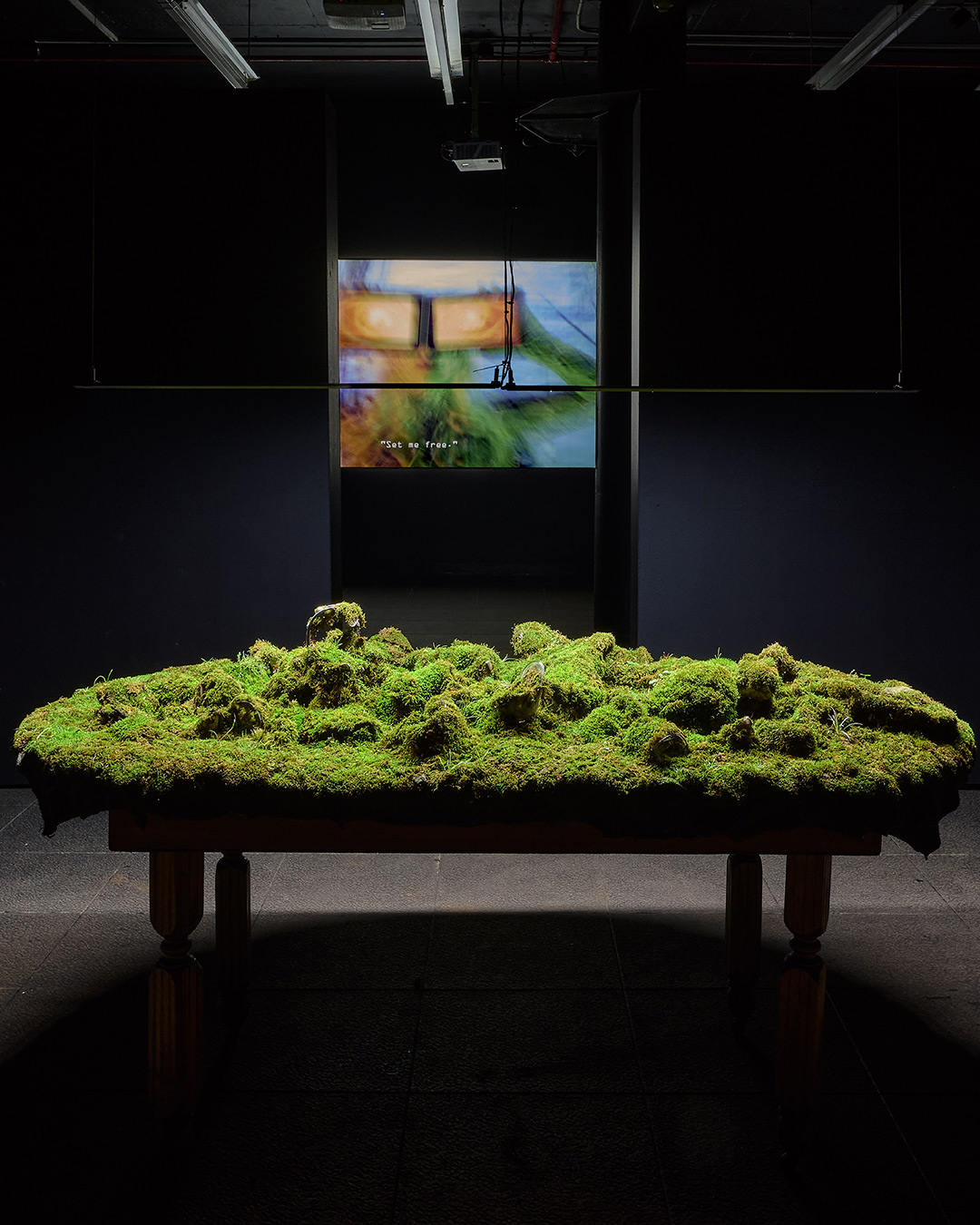
Leftovers at the table (or, what we are left with) (2025); Varieties of moss, wood, stones, soil, glass, silverware, porcelain, blanket, plastic; 1,8 x 1 x 1 m; Courtesy of the artist
Art is where the becomings of the earth couple with the becomings of life to produce intensities and sensations that in themselves summon up a new kind of life.[i]
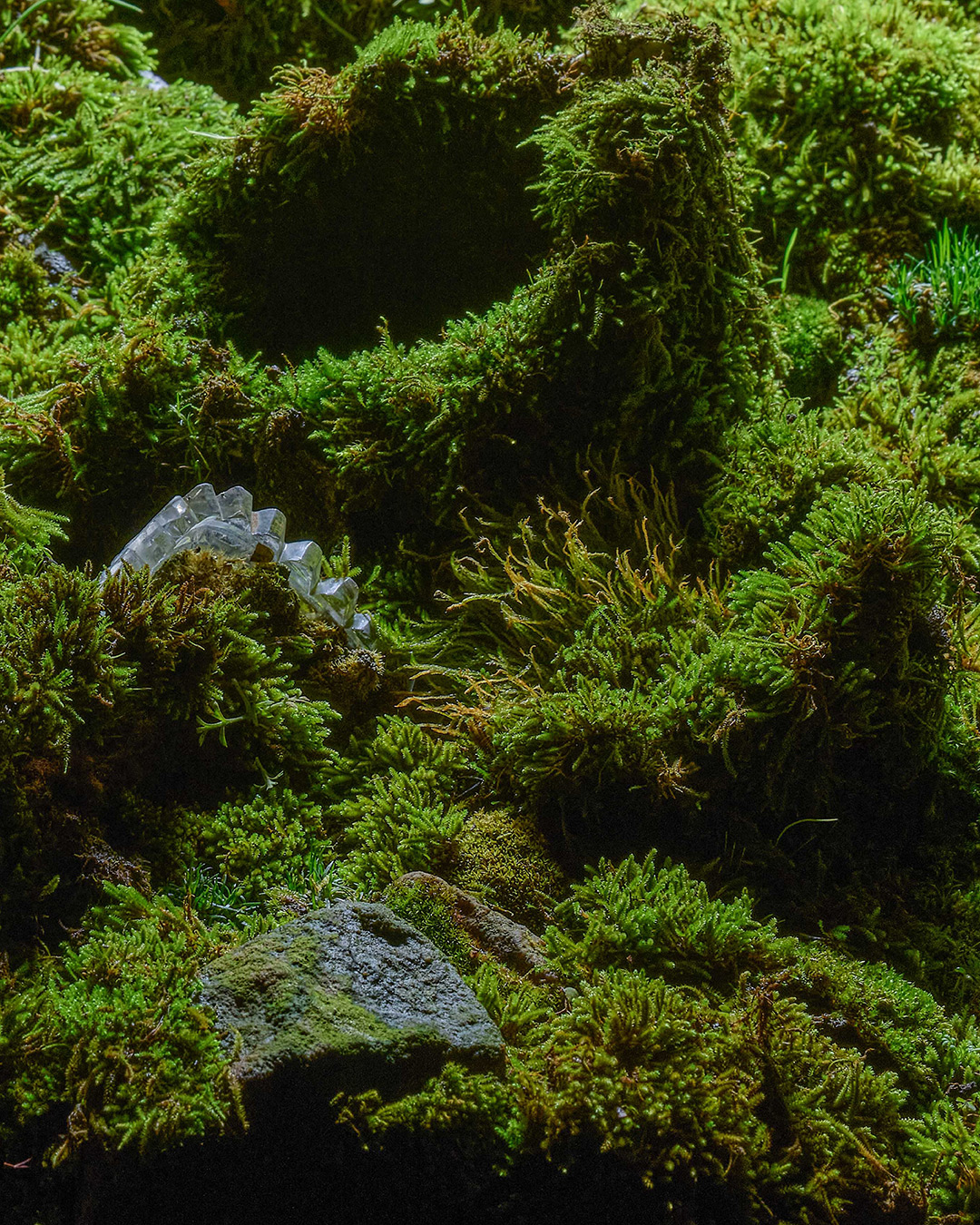
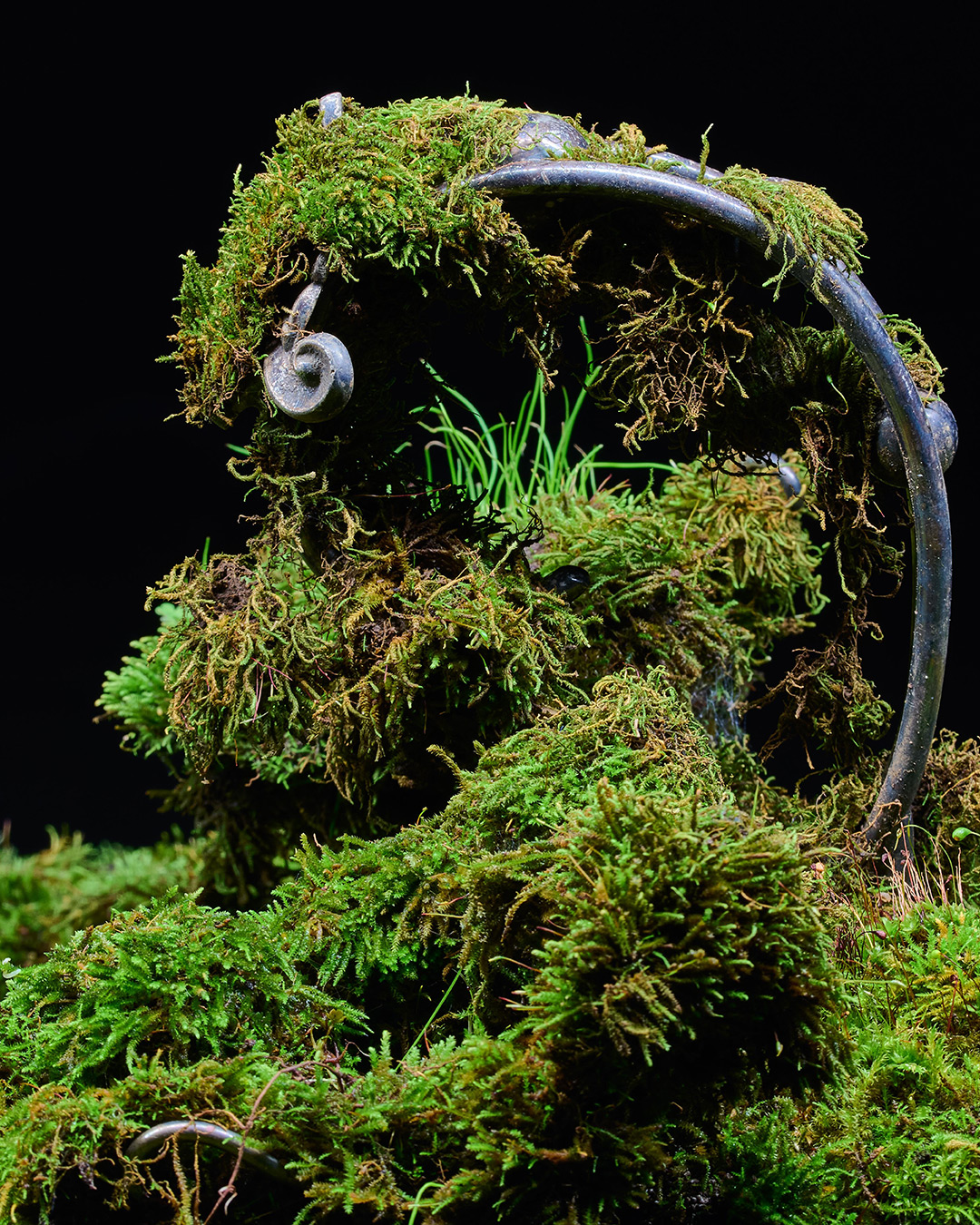
Upon close looking, it becomes evident that beneath the mossy ‘tablecloth’ (or shroud), the mis en scène shows remnants of a formal dinner party in a middle to upper-class settler-colonial home. Items from English bone china dinner-, glass- and silverware – either intact, or as fragments and shards – are scattered over the surface of a ‘Colonial-style’ wooden dining room table. Some are buried under or covered by a thick tablecloth made from various types of moss. Being non-vascular plants, the mosses cover, conceal, erase and even obliterate the objects, leaving only a hint of their shape and form.
As Ann Laura Stoler notes, “Imperial projects are themselves processes of ongoing ruination, processes that ‘bring ruin upon’, exerting material and social force in the present”.[ii] Reminiscent of old graveyards with tombstones and graves covered in moss, these relics of domestic objects-as ruins conversely speak to the demise of settler-colonial heritages, traditions, values, inheritances and generations. Here, the Wedgwood plate, the Royal Doulton teacup, the silver spoon, the cut glass bowl, the crystal wine glass and the spongy tablecloth become storied matter: through the material and visual language of the domestic, they collectively narrate the violent histories of European settler-colonialism and prolonged imperial processes that persistently saturate the subsoil of the post-colony. As Stoler puts it,
These imperial formations persist in their material debris, in ruined landscapes and through the social ruination of people’s lives… [they] reside in the corroded hollows of landscapes, in the gutted infrastructures of segregated cityscapes and in the microecologies of matter and mind.[iii]
As storied matter, these objects-as-ruins resonate as spectral traces of the violent colonial legacies that haunt domestic interiors and broader individual and collective imaginations in post-colonies. These leftovers at the table, or what Stoler calls “Imperial debris”, refer to “’what we are ‘left with’: to what remains, to the aftershocks of empire, to the material and social afterlife of structures, sensibilities, and things”.[iv] In a South African context, they carry hauntological resonances of British and Dutch Imperialism and colonialism – the very mechanisms that drove the enculturation of capital. Sugar, tea, spices and porcelain were commodities that were shipped by the Dutch East India and the British East India companies to the colonies alongside enslaved peoples, themselves considered fungible objects of trade. Read against this historical backdrop of dispossession, exploitation, displacement and precarity, the objects may be seen as uncanny spectres of disquietude – their phantasmic presences evoke an ontology haunted by disjunct, invisible-yet present traces of a troubled past, where the familiar harbours a disquieting strangeness. This is not the ruin of the catastrophic, caused through the violence of war, but rather, the slow, incremental, often imperceptible processes of decomposition, degradation and decay that take place ‘below the surface’ of human consciousness; relics of colonialism to which many remain inextricably bound, Yet, these processes of demise and disintegration are intertwined with a sense of vital refiguration through the growth of the new. Representing renewal, resilience and the interconnectedness of the living and non/living,[v] the vibrant mosses lay foundations for new plants, new knowledges and new ways of being to flourish.




Sources
[1] Farber, L. [no date]. Curriculum Vitae. Available at: https://johannesburg.academia.edu/LeoraFarber/CurriculumVitae [Accessed: 10 June 2025].
[2] Arts Research Africa and Farber, L. 2023. From visual identities to bioart: Leora Farber and the VIAD Research Centre. iono.fm. Available at: https://iono.fm/e/1254754 [Accessed: 10 June 2025].
[3] VIAD. [no date]. Leora Farber — VIAD. Available at: https://www.viad.co.za/leora-farber [Accessed: 10 June 2025].
[4] Farber, L. 2012. Representations of Displacement in the Exhibition ‘Dis-Location/Re-Location’. Doctoral Dissertation, University of Pretoria.
5 Stoler, AL. 2008. Imperial Debris: Reflections on Ruins and Ruination. Cultural Anthropology 23, 2.
[i] Grosz, E. 2008. Chaos, Territory, Art: Deleuze and the Framing of Earth. New York: Columbia University Press:79.
[ii] Stoler, AL. 2008. Imperial Debris: Reflections on Ruins and Ruination. Cultural Anthropology 23, 2:195
[iii] Stoler, AL. Ibid:194.
[iv] Stoler, AL. Ibid: 194.
[v] Radomska, M. 2016. ‘Uncontainable Life. A Biophilosophy of Bioart’. PhD thesis submitted to Linköping Studies in Arts and Science, No. 666, Department of Thematic Studies – Gender Studies:35.
MEET THE ARTISTS


