ORON CATTS AND IONAT ZURR
Biography
Long-time collaborative partners, Oron Catts and Ionat Zurr work at the intersections of science and art. Together they have pioneered the field becoming globally recognised for their contributions to the fields of biological art and art and science education.
Born in Finland and later settling in Australia, Oron Catts studied product design and was greatly influenced by ecological design within design practices.[1] Following the boom of technological projects that changed how we think of life, from the Human Genome Project which launched in 1990 to the cloning of Dolly the sheep in 1996, Catts began to ask how these new technologies would change design from something that is manufactured to something that is grown. The more he delved into these questions, the more interested he became in the ethics, possibilities, and problems that emerged with these new technologies, rather than their solutions.[2]
Dr. Ionat Zurr was born in England, later moving to Australia. She studied photography and media studies, specialising in biological and digital imaging.[3] Alongside Catts, she was inspired by the Vacanti mouse, a mouse with a human-like ear shape grown on its back from the mid 1990s. As an artist, she viewed her role as someone who should contribute and subvert these developing technologies. Initially thinking she would be going into the lab to photograph how these new technologies are developed, Zurr was surprised by the opportunities to grow the tissue to create the works she and Catts wanted to explore.[4] She remarked that once she began to work with life, “the idea of representation became a secondary thing” and that the “phenomenological experience of being able to mess with life and what it entails, that easiness, was very strong”.[5] In 2008 she won the Robert Street Prize for her PhD thesis which is awarded to graduate students at the University of Western Australia whose research is viewed as having the most outstanding contribution to their field.[6]
In 1996, Catts and Zurr established the Tissue, Culture & Art Project (TC&A Project) which has continued to pioneer investigation into tissue engineering as a medium for artistic expression. The TC&A Project explores artistic expression through the medium of tissue engineering. This ongoing project reflects the changing relationship between the human and nonhuman and engineered tissue. The TC&A Project has developed artworks, curated exhibitions, staged performances, and contributed to academic scholarship on this relationship and the impact of tissue engineering.[7]
In 1996, the Catts and Zurr were awarded a small grant from the Perth Institute of Contemporary Art to answer the question: can we manipulate living tissue as a form of artistic expression or within a cultural context? As a result of the grant, they joined scientists Miranda Grounds (who researched muscle regeneration) and Trian Chirila (polymer and organic chemist)whose interdisciplinary teams of researchers working on tissue engineering, taught Catts and Zurr how to use the scientific equipment and different methods and techniques to use in the lab.[8] Being in Perth at this time was a great benefit for the two, allowing them access to open-ended grants that enabled them to learn the skills and develop initial work that helped them gain access to other grants, such as Western Australia Lottery Commission which they were awarded and which they used to launch SymbioticA.[9]
Following on from the success of the TC&A, in 2000, Catts launched SymbioticA alongside biologist Miranda Grounds and neuroscientist Stuart Bunt at the University of Western Australia. SymbioticA was the world’s first laboratory space where artists would directly work with biological research through wet lab practices. Together with Zurr, under Catts’ leadership, SymbioticA pioneered art and science education, research, and design becoming a globally leading research centre at the intersection of art and science.[10] SymbioticA became an independent research lab in 2024.
In 2002, SymbioticA presented its first survey show of work produced since Catts and Zurr began exploring bio-art in 1996. The exhibition, ‘BioFeel’ brought together some of the work created by Tissue, Culture & Art Project work produced at SymbioticA and by other intentional and Australian artists working with biological technologies, showing the largest collection biological art works at the time. ‘BioFeel’ was accompanied by a symposium, ‘The Aesthetics of Care?’, which focused on how biological and medical technologies are employed in the creation of manipulated living systems and how this is debated from ethical, artistic, legal, scientific, and academic viewpoints.[11] This impressive exhibition gave Catts and Zurr the recognition they needed to approach the University of Western Australia for ongoing funding for SymbioticA.[12]
Oron Catts and Ionat Zurr were the first ever artists-in-residence in a research lab at Harvard Medical School, within the Laboratory for Tissue Engineering and Organ Fabrication, housed in the Massachusetts General Hospital, Boston (USA) from 2000-2001. They worked with the creator of the Vacanti mouse, Joseph Vacanti. Their experiences at Harvard inspired the way they wanted to run SymbioticA, as a non-hierarchical space, where artists and scientists were viewed as equals and given access to the same resources. This can be seen clearly through the Masters programme, developed by Zurr, which was hosted by SymbioticA, a MSc in Biological Arts, open to graduate students from any background, with the condition that they emerged with both scientific and artistic training.[13] For Catts, the role of the artist is to engage with the scientific world and experiment with science using artistic methodologies to do things that the discipline of science cannot do.[14] Both scientists and artists involved in Catts and Zurr’s projects are encouraged to think critically with the new disciplines they are being exposed to, how these forms of knowledge and their techniques and methods can be applied and to be involved throughout their different processes.[15] While their work is transdisciplinary, they still want to ensure disciplinary integrity.[16]
From 2011-2013, Catts and Zurr worked alongside Helena Senderholm, Ulla Taipale, and Mairka Hellman to establish the Biofilia – Base for Biological Arts. Biofilia is a lab dedicated to biological art based at Aalto University in Finland.[17] The unit was established in 2012 with the guidance of Catts and Zurr, and later in 2014 it was where they both served as Visiting Professors.[18] Since establishing the TC&A Project, the two have been invited to fellowship programmes across the world. Following on from their time at Harvard University, Catts and Zurr were a Visiting Scholars at the Department of Art and Art History at Stanford University in 2007.[19] In 2014 Catts and Zurr were Visiting Fellows at the Techē Institute for Arts and Emerging Technologies in Buffalo University in New York City, Catts also served at the Royal College of Arts in London, UK as Visiting Professor of Design Interaction (2009-2012) Professor at Large in Contestable Design (2015-2017) and Visiting Professor in Design Futures, (2020-2021).[20] In 2025 Catts was appointed as a Visiting Professor in the Visual Identities in Art and Design Research Centre, University of Johannesburg.
In the early days of the Tissue Culture & Art Project, Oron Catts and Ionat Zurr coined the term ‘semi-living’ which they used to describe living tissue, that has been constructed or grown out of tissue matter taken from complex organisms and were are alive with the assistance of technological interventions.[21] Growing semi-living art was also the topic Ionat Zurr wrote about in her PhD thesis.[22] Semi-living sculptures imitate body conditions as they grow up in artificial conditions. As part of their exhibitions where semi-living projects are exhibited, they include a killing ritual to close off the exhibition. This killing ritual is described by Catts as being ‘the most pronounced act of violence in the work of TC&A”.[23] The killing ritual takes place when nobody can care for the semi-living sculpture any longer, raising questions around compassion, euthanasia, and care.[24]
In 2007, under the leadership of Catts, SymbioticA won the inaugural Prix Ars Electronica Golden Nica in Hybrid Art, and the Western Australia Premier Science Award in 2008. Most recently, Catts and Zurr were awarded a Distinction for their 3SDC project with Steve Berrick at the Prix Ars Electronica, and the film shot to be part of the 3SDC project won the Innovation Award for Best Alternative Content at the 2024 West Australian Screen Culture Awards.[25] In addition, in 2009, Icon Magazine named Oron Catts and Ionat Zurr in their ‘Top 20 Designers making the future and transforming the way we work’ and Thames and Hudson featured them as their ‘60 Innovators Shaping our Creative Future’.
Their work has been shown in museums and galleries across the world, such as the Pompidou Centre in France, Museum of Modern Art in New York City, National Art Museum of China, the Mori Art Museum in Japan, and Yerba Buena Center for the Arts in San Francisco. Together their work has been part of over thirty exhibitions.
Ionat Zurr and Oron Catts continue to shape the field of biological art through their active engagement with developing new language through their artworks and exhibitions. In addition, they contribute to the academic field by exploring the ethics, aesthetics, and the implications of cell and tissue engineering on everyday life, having authored and co-authored overseventy articles. Their work has been widely regarded for its contribution to the question ‘what is life?’ and for the innovative and expansive ways they consider this topic.


ARTISTS STATEMENTS
Fever 24°C–45°C (2024): Looped circular time lapse video; 02:24; Courtesy of the artists
Since 1800, global temperatures have risen by over 1°C with 2024 recorded as the hottest year ever. As global temperatures continue to rise within the climate catastrophe, key research questions are: What will happen to our cells and our bodies as temperatures continue to rise? Furthermore, what will the planetary impact of global heating be? And, what would it mean to ‘cook’ cells?
The T-cell was then prepared for microscopy, and filmed using an electron microscope to visualize and record its cellular structures and processes at very high magnification and resolution. Time-lapse microscopy was also used to capture the movement of cellular activity over time.
Fever 24°C-45°C is presented as a looped circular time lapse video, with a duration of approximately 2 minutes. The work is presented as projected on a 3D concave screen which enhances the perception of a globe or 3D sphere. Within the video a single immune mouse T-cell floats in space. Mouse T-cells are similar to a human T-cells because they share similarities in their development, their function and their response to antigens. Under the microscope, the cell looks like a planet upon which the organelles move around like tectonic plates. As the temperature rises from room temperature (24°c) to (45°c), the cytoplasm bursts like a volcano, and the mitochondria rupture spraying its innards throughout the cell.
Situated within broader tissue culture research, Fever 24°C-45°C demonstrates the impact global warming will have on our immune systems, literally causing our cells to burst as temperatures continue to rise. Within the field of Bioart, this work sits at the intersection between climate change, the climate catastrophe and the microbiological, as it alludes to the impact that global heating will have both on a cellular and planetary scale.
It draws connections between the micro-organism, the cell, and the planetary structure, illustrating how both of these will be impacted. As the mouse T-cell simulates the cells in the human body, we see it attempt to maintain homeostasis under immense pressure. This project raises the alarm as to what will happen to human cells should temperatures continue to rise and unless urgent action is taken to address global warming.
Fever 24°C-45°C contributes to the burgeoning field of art-science collaborations by visually simulating the impact of rising temperatures on the human body, using a mouse T-cell. The similarities between the way in which a mouse T-cell and human cells react under extreme heat ensures that viewers can visualise what will happen to their cells at high temperatures and raises questions about the living bodies’ ability to acclimatise to such calamity.
It is no longer just cell biologists, but scientists from many other disciplines, such as immunology and neuroscience, that utilise movies to dissect their processes of interest.
Most cell biologists these days are also cinematographers. Making movies of the cells, tissues and embryos that we study under a microscope is a regular occurrence in the laboratory. Like cinematographers working on any cinematic production, we are in charge of the technical aspects of filming. We choose the type of microscope and microscope lens, along with deciding on the lighting of our ‘actors’. To be clear, there is no director in these productions; the cells are responsible for their own performance and we are only there to facilitate their storytelling. This approach is certainly not unique. Movie making is now commonplace in virtually all biological disciplines and is part of any experimentalist’s toolkit. When did making movies of cells become such a standard technique? Who were the pioneers of ‘cinema photomicrography’ as it was originally known? A number of research groups in the UK played a central role in the early development of tissue culture and cinema photomicrography, with many working at the Strangeways Research Laboratory in Cambridge (Wilson, 2005). With the help of the Wellcome Library, films that had been sitting on a shelf in our laboratory from two Strangeway’s cinemicroscopists (Fig. 1) have been digitized and are now freely available on their website for all to see.
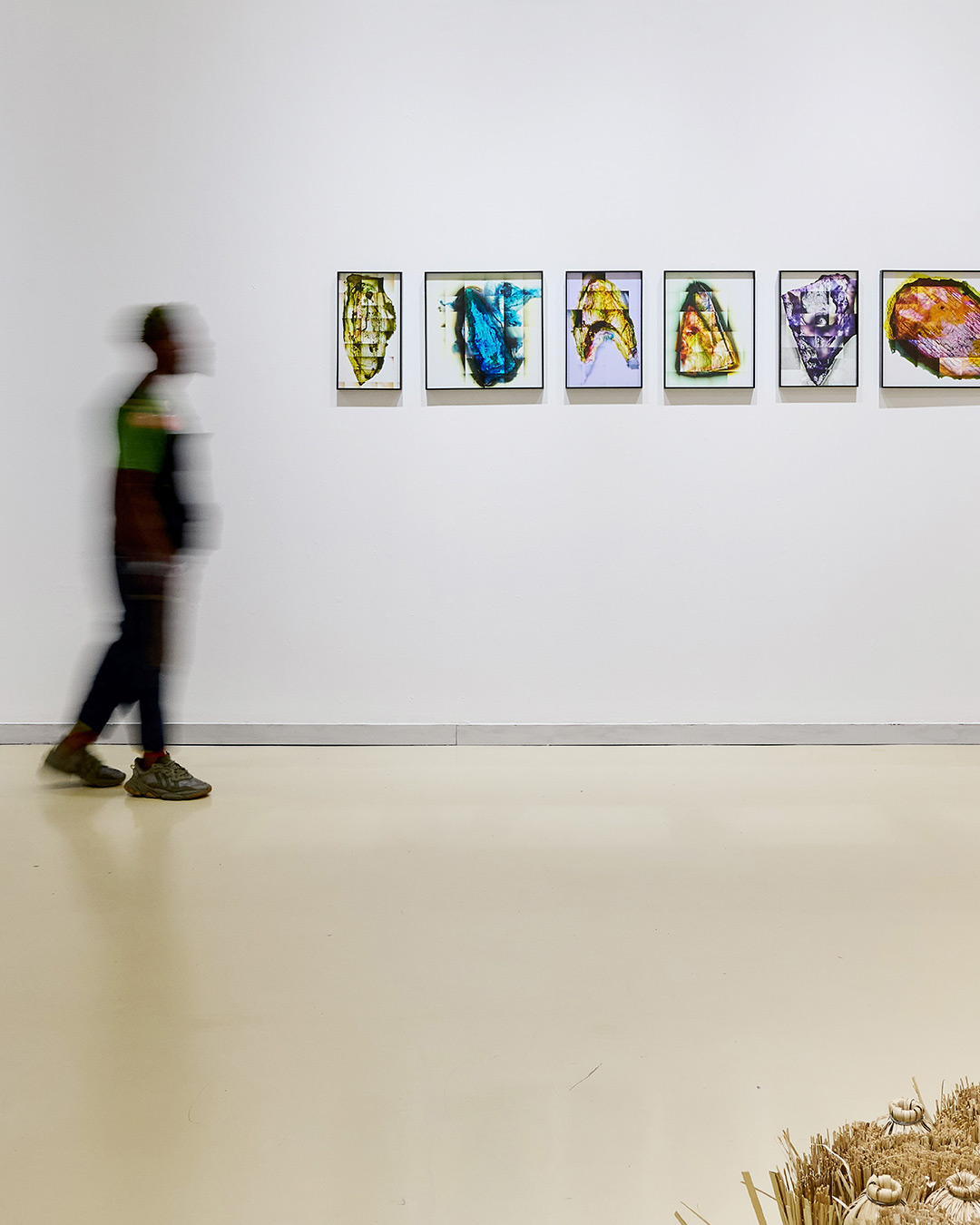
The Stone Age of Biology – Spear, Arrow, Round, Sharp 1, Sharp 2, Cutstone (2000): Digital prints on Irridium Silver Gloss 250gsm; 42 x 22.8 cm, 42 x 42.2 cm, 42 x 27.3 cm, 42 x 54,1 cm, 42 x 28.2 cm, 42 x 52 cm; Courtesy of the artists
The evolution of technology ushered in a number of major developments. These developments changed the perception of humans toward their environment. One of the very first of these changes was the realisation that stones can be chipped to form functional tools. Only the humans that could build a mental three-dimensional representation of a finished tool and who had the cognitive ability to plan ahead and manually construct the tools could survive the game of natural selection. For them nature became a resource for raw materials for tool production. This mental shift separated humans from nature for the first time, and we never looked back. We are now, for the first time, treating living nature (including ourselves) as a resource for new biological tools that will be part of our manufactured environment. What kind of mental shift we will go through? How will we treat our biological bodies? How will we perceive manufactured living matter? How much technology will invade the body? And how much of the body will invade technology?
For The Stone Age of Biology, we grew muscle and nerve tissue over miniaturised replicas of pre-historic stone tools. The Stone Age of Biology can be seen as the lines on the walls of our new cave. The development of stone tools transformed us from being ‘intelligent apes’ to what we are now. The mental shift that made the apes toolmakers is now being repeated. The development of biological tools will change us in ways that we cannot even imagine.
The fusion of cultured tissue and bio-friendly polymer miniaturised replicas has resulted in what we refer to as semi-living objects. These objects are still in the realm of a symbolic gesture representing a new class of object/being. These objects, partly artificially constructed and partly grown, consist of synthetic materials as well as living biological matter.
The artwork emanates from the Tissue Culture & Art Project which is built on the strong belief that biologically related technologies are going to have a dramatic effect on human evolution and human history in the near future. The TC&A project utilises biologically related technologies as a new form of artistic expression to focus attention and challenge perceptions regarding the fact that these technologies exist, are being utilised, and will have even more dramatic effect in the future.


Sources
[1] Biennale of Electronic Arts Perth. 2022. Available at: https://mass.nomad.net.au/wp-content/uploads/beap/2002/program/pdf/BEAP%202002-Biofeel%20.pdf [Accessed: 8 May 2025].
[2] Catts, O. 2025. The strangeness of what’s happening: Interview with Oron Catts — Hybrid Arts. Hybrid Arts. Available at: https://www.hyb.art/blog/8 [Accessed: 1 May 2025].
[3] Biennale of Electronic Arts Perth. 2022. Available at: https://mass.nomad.net.au/wp-content/uploads/beap/2002/program/pdf/BEAP%202002-Biofeel%20.pdf [Accessed: 8 May 2025].
[4] Queensland Art Gallery and Gallery of Modern Art. 2011. Ionat Zurr | Brisbane Interview. Available at: https://www.youtube.com/watch?v=1Bibp4clI5A [Accessed: 8 May 2025].
[5] Queensland Art Gallery and Gallery of Modern Art. 2011. Ionat Zurr | Brisbane Interview. Available at: https://www.youtube.com/watch?v=1Bibp4clI5A [Accessed: 8 May 2025].
[7] The Tissue Culture & Art Project. [no date]. About. Available at: https://tcaproject.net/about/ [Accessed: 1 May 2025].
[8] Catts, O. 2025. The strangeness of what’s happening: Interview with Oron Catts — Hybrid Arts. Hybrid Arts. Available at: https://www.hyb.art/blog/8 [Accessed: 1 May 2025].
[9] National Association for the Visual Arts. 2020. NAVA Artist File: Ionat Zurr. Available at: https://www.youtube.com/watch?v=DWrPre_b5xE [Accessed: 8 May 2025]. And Oron, C. 2025. The strangeness of what’s happening: Interview with Oron Catts — Hybrid Arts. Hybrid Arts. Available at: https://www.hyb.art/blog/8 [Accessed: 1 May 2025].
[10] O’Reilly, K. 2022. Save SymbioticA. Change.org. 13 October. Available at: https://www.change.org/p/save-symbiotica?utm_source=share_petition&utm_medium=custom_url&recruited_by_id=b23c7bb0-be5b-012f-2dce-4040496dcccb [Accessed: 18 April 2025].
[11] Biennale of Electronic Arts Perth. 2022. Available at: https://mass.nomad.net.au/wp-content/uploads/beap/2002/program/pdf/BEAP%202002-Biofeel%20.pdf [Accessed: 8 May 2025].
[12] Catts, O. 2025. The strangeness of what’s happening: Interview with Oron Catts — Hybrid Arts. Hybrid Arts. Available at: https://www.hyb.art/blog/8 [Accessed: 1 May 2025].
[13] Catts, O. 2025. The strangeness of what’s happening: Interview with Oron Catts — Hybrid Arts. Hybrid Arts. Available at: https://www.hyb.art/blog/8 [Accessed: 1 May 2025].
[14] Art Gallery of Western Australia. 2018. Art vs. Science: A Discussion with Oron Catts. Available at: https://artgallerywablog.wordpress.com/2018/09/26/art-vs-science-a-discussion-with-oron-catts/ [Accessed: 8 May 2025].
[15] Catts, O. 2004. SEMI-LIVING ART: Interview with Oron Catts. Cluster. Available at: https://domenicoquaranta.com/public/TEXTS/2004_interview_oron_catts.pdf [Accessed: 16 May 2025].
[16] Catts, O. 2025. The strangeness of what’s happening: Interview with Oron Catts — Hybrid Arts. Hybrid Arts. Available at: https://www.hyb.art/blog/8 [Accessed: 1 May 2025].
[17] Aalto University. [no date]. History of Biofilia. Available at: https://www.aalto.fi/en/biofilia/history-of-biofilia [Accessed: 10 June 2025].
[18] The Tissue Culture & Art Project. [no date]. About. Available at: https://tcaproject.net/about/ [Accessed: 10 June 2025].
[19] University of Western Australia. [no date]. Ionat Zurr. Available at: https://research-repository.uwa.edu.au/en/persons/ionat-zurr/prizes/ [Accessed: 10 June 2025].
[20] University of Western Australia. [no date]. Oron Catts https://research-repository.uwa.edu.au/en/persons/oron-catts [Accessed: 16 June 2025].
[21] Leonardo Abstract Services. 2009. Growing Semi-Living Art By Ionat Zurr and Oron Catts. Available at: https://www.leoalmanac.org/growing-semi-living-art-by-ionat-zurr-and-oron-catts/ [Accessed: 8 May 2025].
[22] Zurr, I. 2008. Growing Semi-Living Art. Doctoral Dissertation, University of Western Australia. Available at: https://research-repository.uwa.edu.au/en/publications/growing-semi-living-art [Accessed: 10 June 2025].
[23] Catts, O. 2004. SEMI-LIVING ART: Interview with Oron Catts. Cluster. Available at: https://domenicoquaranta.com/public/TEXTS/2004_interview_oron_catts.pdf [Accessed: 16 May 2025].
[24] Catts, O. 2004. SEMI-LIVING ART: Interview with Oron Catts. Cluster. Available at: https://domenicoquaranta.com/public/TEXTS/2004_interview_oron_catts.pdf [Accessed: 16 May 2025].
[25] McGrath, K. [no date]. 3SDC to the Power of 4 Screens — Kenta McGrath. Available at: https://kentamcgrath.com/3sdc-to-the-power-of-4-screens [Accessed: 16 May 2025].
MEET THE ARTISTS