Oupa Sibeko
Biography
Known predominantly for his performance work which are marked by a clear focus on the body, Oupa Sibeko draws on play and aspects of communal and ritual performances, and site-specific performances as a means of creating an exchange of cultural knowledge and healing through his artistic practice.[1]
Born in 1992, in the West Rand, Oupa Sibeko believes that being “born, bred, buttered, toasted, [and] sandwiched” in Johannesburg moulds one to be adaptable, allowing him to move fluidly through different spaces and different forms of making within his artistic practice. Orphaned at a young age and then raised by his Grandmother, Ouma, who named him ‘Oupa’, Sibeko grew up in the West Rand, on a farm near the small town of Zuurbekom.[2] Shortly before her passing, when he was eight years old, his Ouma left him with the words “don’t forget to play”, which influenced Sibeko’s decision to “play everyday” with his art practice.[3] From then on, Sibeko was raised by his uncle with whom he had a fractured relationship.
Sibeko’s relationship with his uncle and the early years he spent with his Ouma greatly shaped his life as he struggled to understand his masculinity and the kind of man he wanted to become. He knew that not all men were neglectful or drunk and as a response he chose to make himself vulnerable through play and performance as he endeavoured to understand Black masculinity.[4] Sibeko is an interdisciplinary artist who centres play and the body, specifically the Black male body as a site of exploration into the implications of re-enacting and re-imagining pain, while also exploring themes of Black pain, negation, and spectacle.[5]
Oupa Sibeko completed both his undergraduate, a Bachelor of Arts in Performance and Visual Arts (2015) and postgraduate degree, a Master of Fine Arts (2021), at the University of the Witwatersrand. During his undergraduate, he was pushed by his lecturers Gerard Bester and Toni Morkel who taught him choreography and encouraged him to strive further than he thought he was capable of doing.[6] In 2019 he was named one of the Mail&Guardian 200 Young South Africans and in reflecting on his artistic practice he remarked, “[t]he body knows things that the mind cannot express and it’s in playing, and being playful, that I can continue becoming.”[7] In the same year, Oupa Sibeko won the David Koloane award and in 2020, he was shortlisted for the Henrike Grohs Art Award.[8]
Following his undergraduate, Oupa Sibeko built his name up as a performance artist in South Africa, where through his satirical approach, Sibeko grapples with topics such as labour and spirituality, and how the Black male body has been made to assimilate to harsh environments.[9] His work has been included in exhibitions at the National Art Gallery of Namibia, Greatmore Studios, Cape Town; The Freezer Hostel and Theatre, Iceland. In 2022 he participated in a print-making residency in the Leipzig International Art Programme where he did a performance piece using ice skates to make an etching plate and print.[10]
For his Masters research, Sibeko turned his focus squarely towards the ocean, healing, and performance. His Masters degree research report brought together African Indigenous Knowledge Systems, and Caribbean and South African oceanic perspectives and rituals to artistically explore beliefs and practices that involve bottled seawater.[11] Within this, he reflects upon his ongoing performance work Black is Blue (2019-), a durational performance work which encourages viewers to rethink urban space through embracing the myth of the inland sea.
In the durational performance work Black is Blue (2019-), Sibeko is found by the audience lying across two deck-chairs, facing downwards to a floor covered in sea salt. Four fish hooks are fixed into Sibeko’s back while a video plays in the background. The video shows a man fishing in a puddle in Johannesburg, providing a comical relief from the sight of the hooks in Oupa’s skin.[12] Within Black is Blue (2019-), the body is imbued with notions of power, vulnerability, and objectification, as well as the capacity for violence and intimacy through how it exists publicly, privately and commercially. In calling for a return to the sea, Sibeko’s body becomes the location from which we can repair wounds, seek spiritual grounding, and rethink belonging in the urban environment of Johannesburg through a connection to the sea.[13] Black is Blue (2019-) was performed across South Africa and France, including at the Nel Art Gallery in Cape Town, South Africa, La Friche in Marseille, France, and at the National Arts Festival in 2021 in Makhanda South Africa.[14]
In striving to understand who he is and how to be in the world, Oupa Sibeko’s artistic career has taken play and used it as a source of levity to guide his interactions with the world. Within the performance spaces he creates, where affective encounters and ritual blend with the satirical, Sibeko hopes to create reparative moments from which we can understand new ways of being with ourselves, one another, and the wider world. Sibeko plays with the historical past, the present, and his imaginations of/for the future, where time becomes cyclical and spiritually-connected, and the body politic of the past is re-negotiated in the present through movement and play.

ARTIST STATEMENT
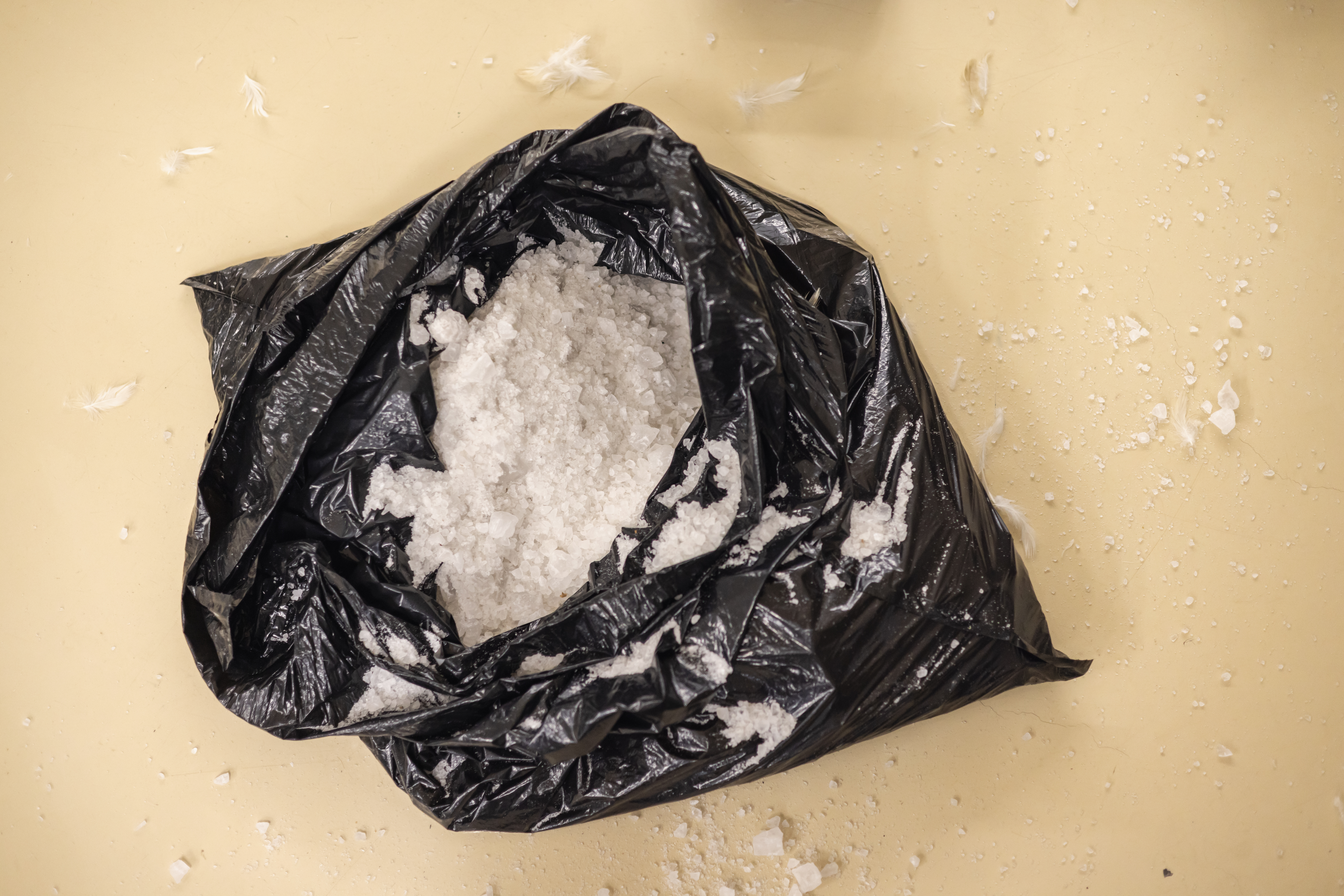
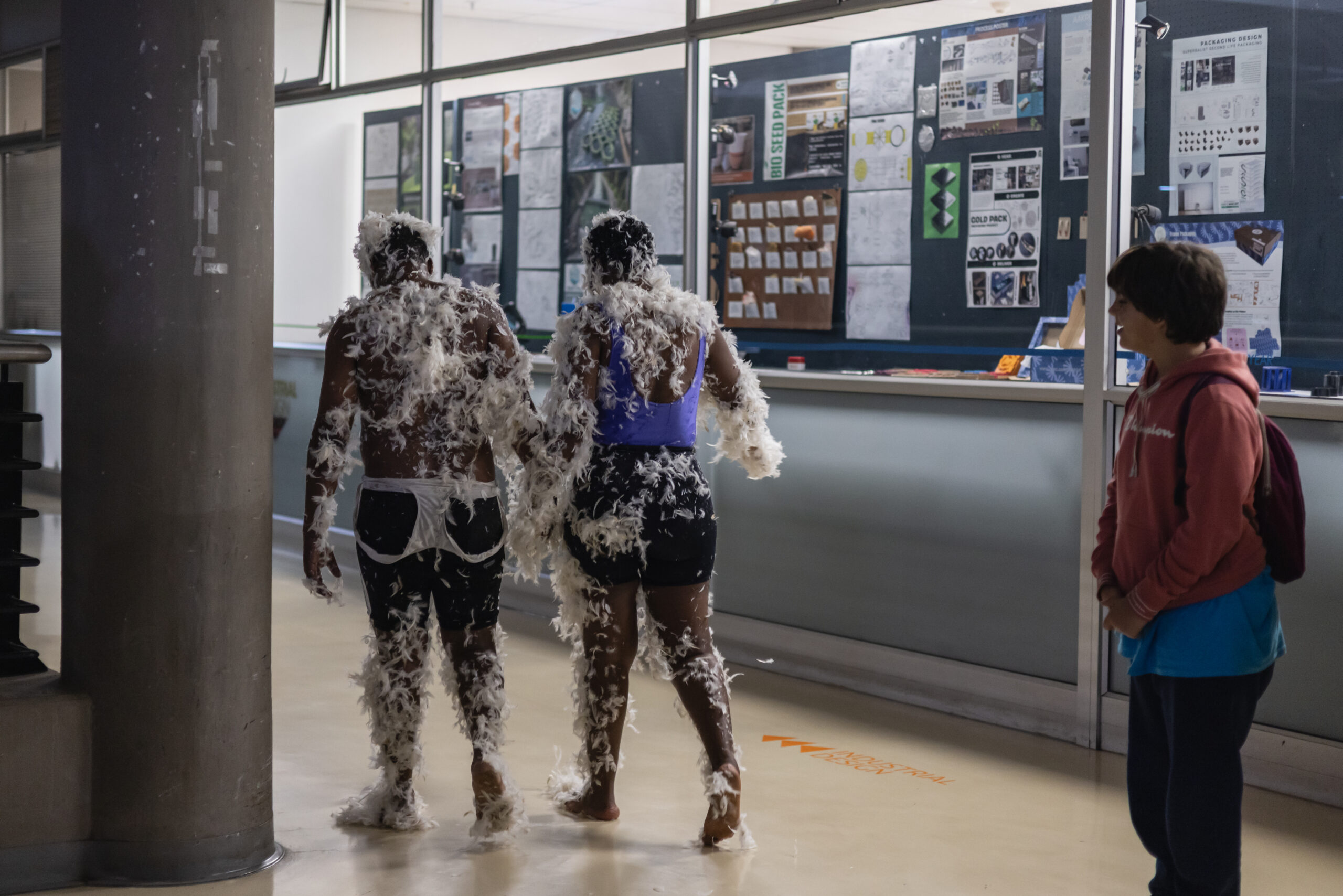
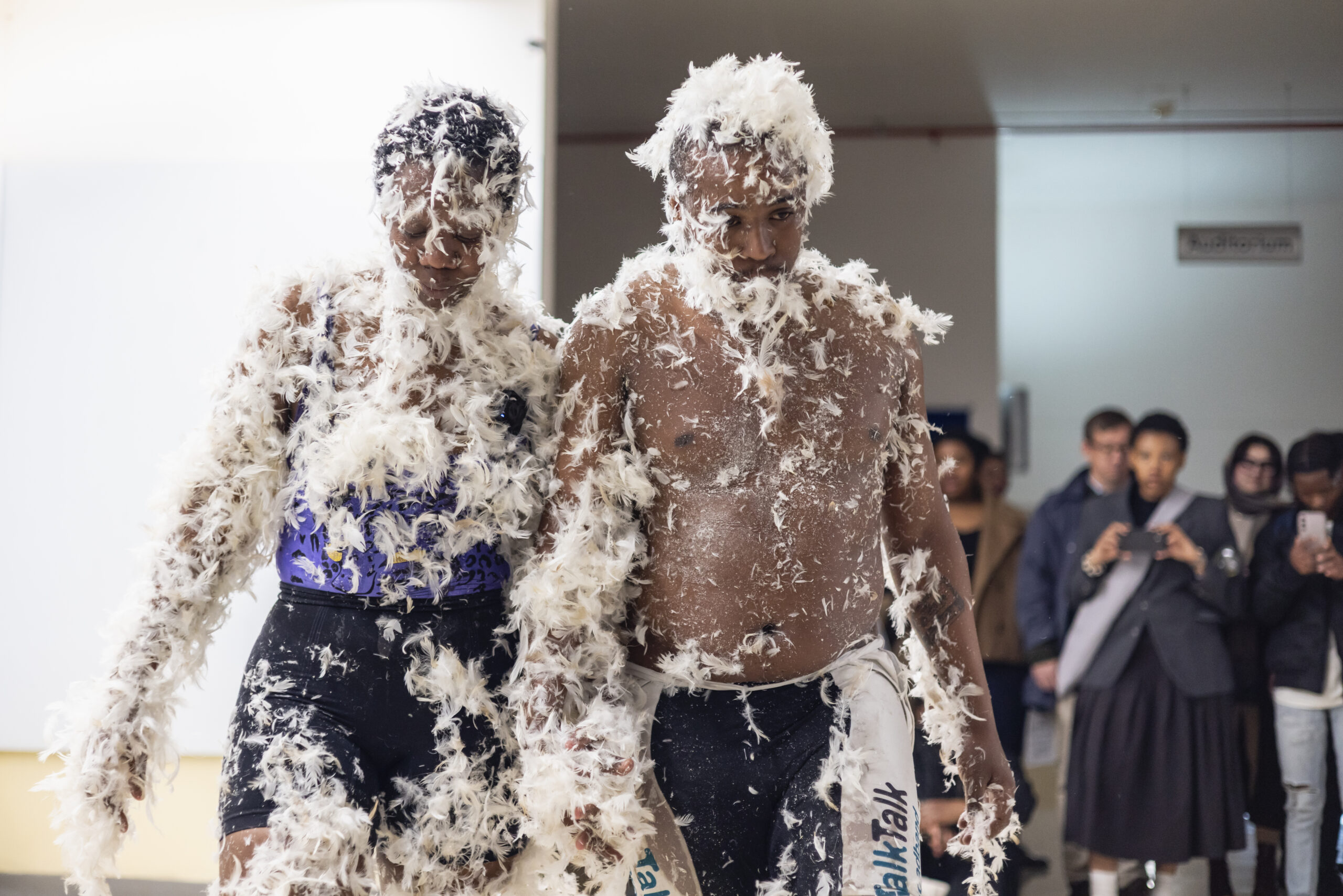
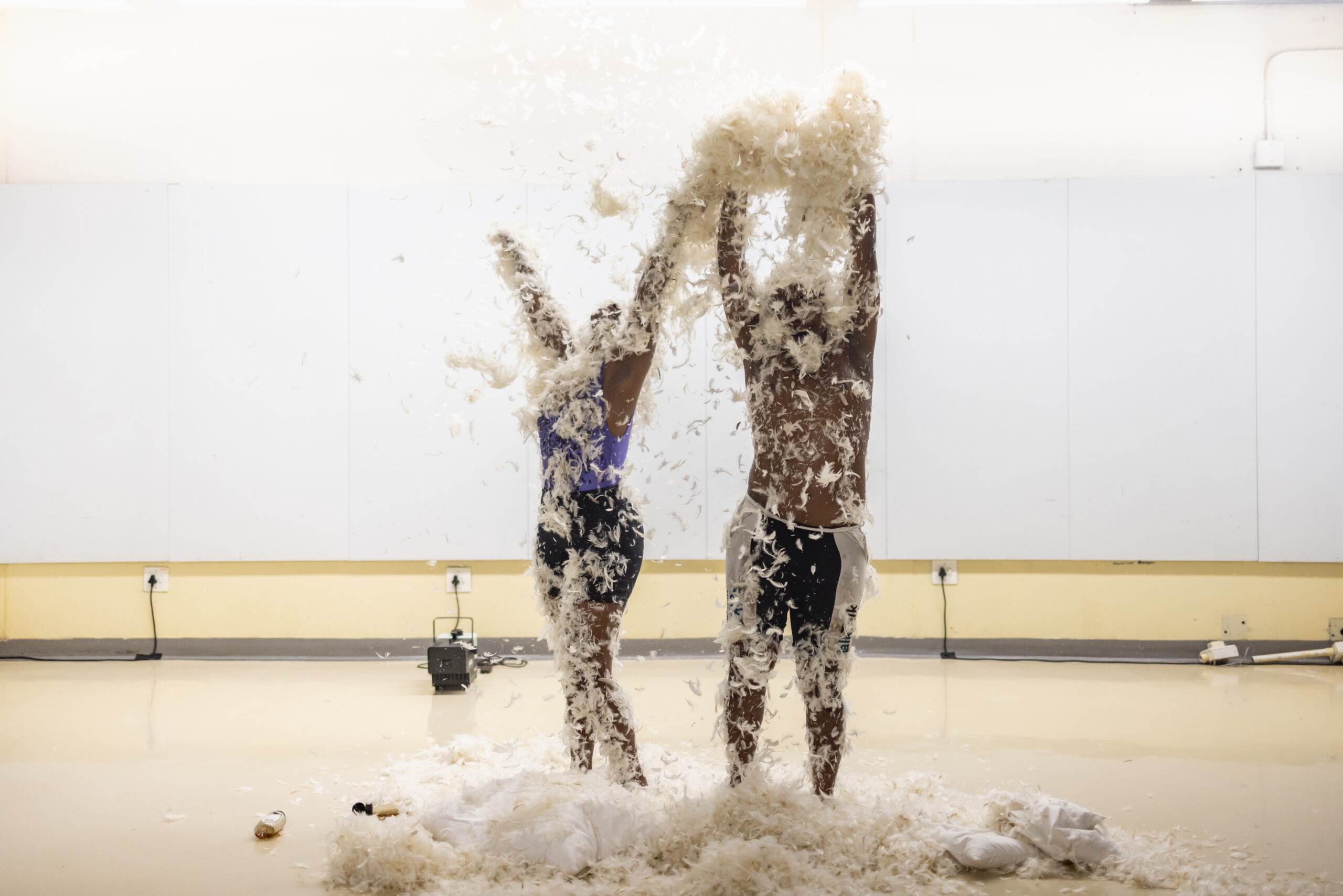
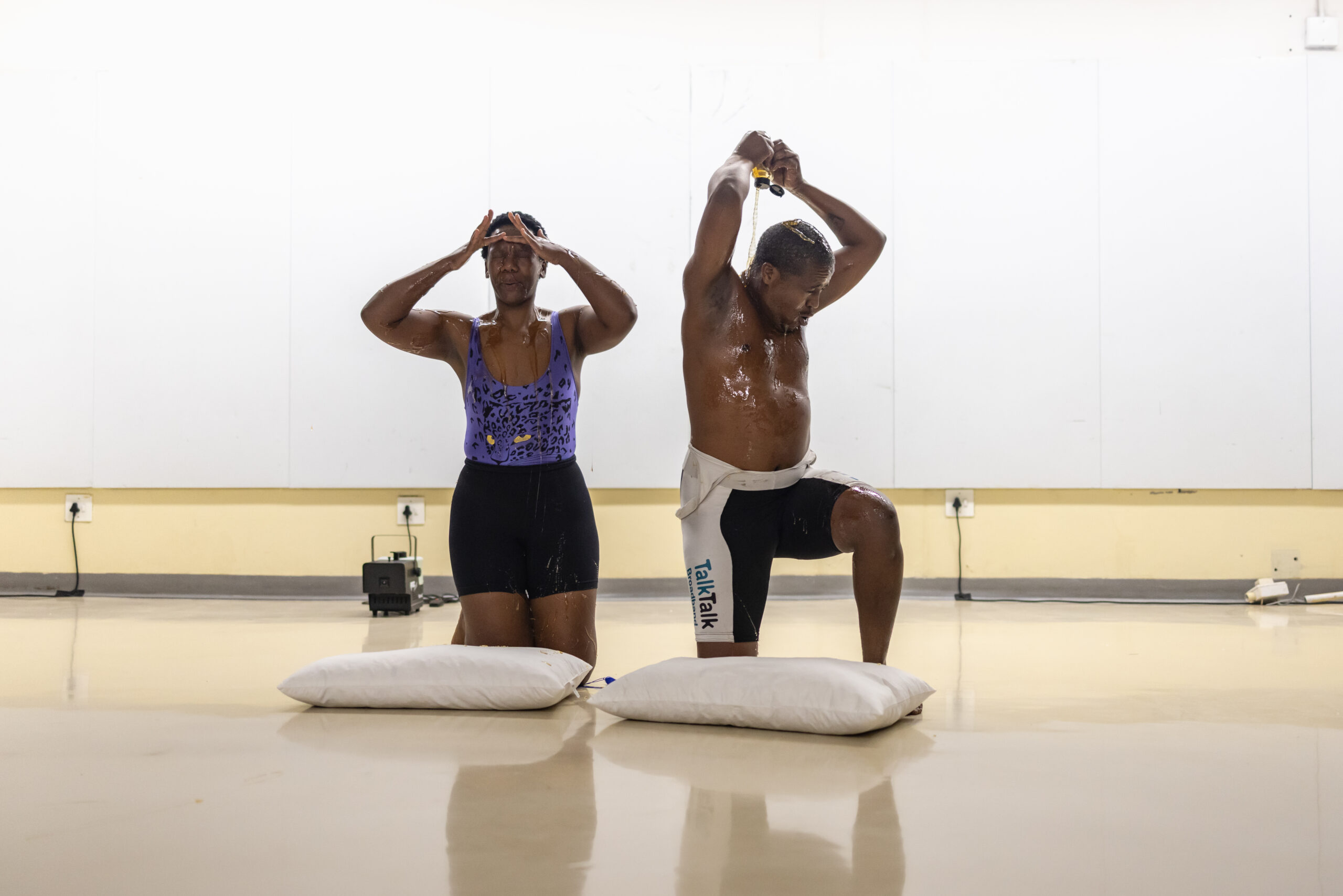
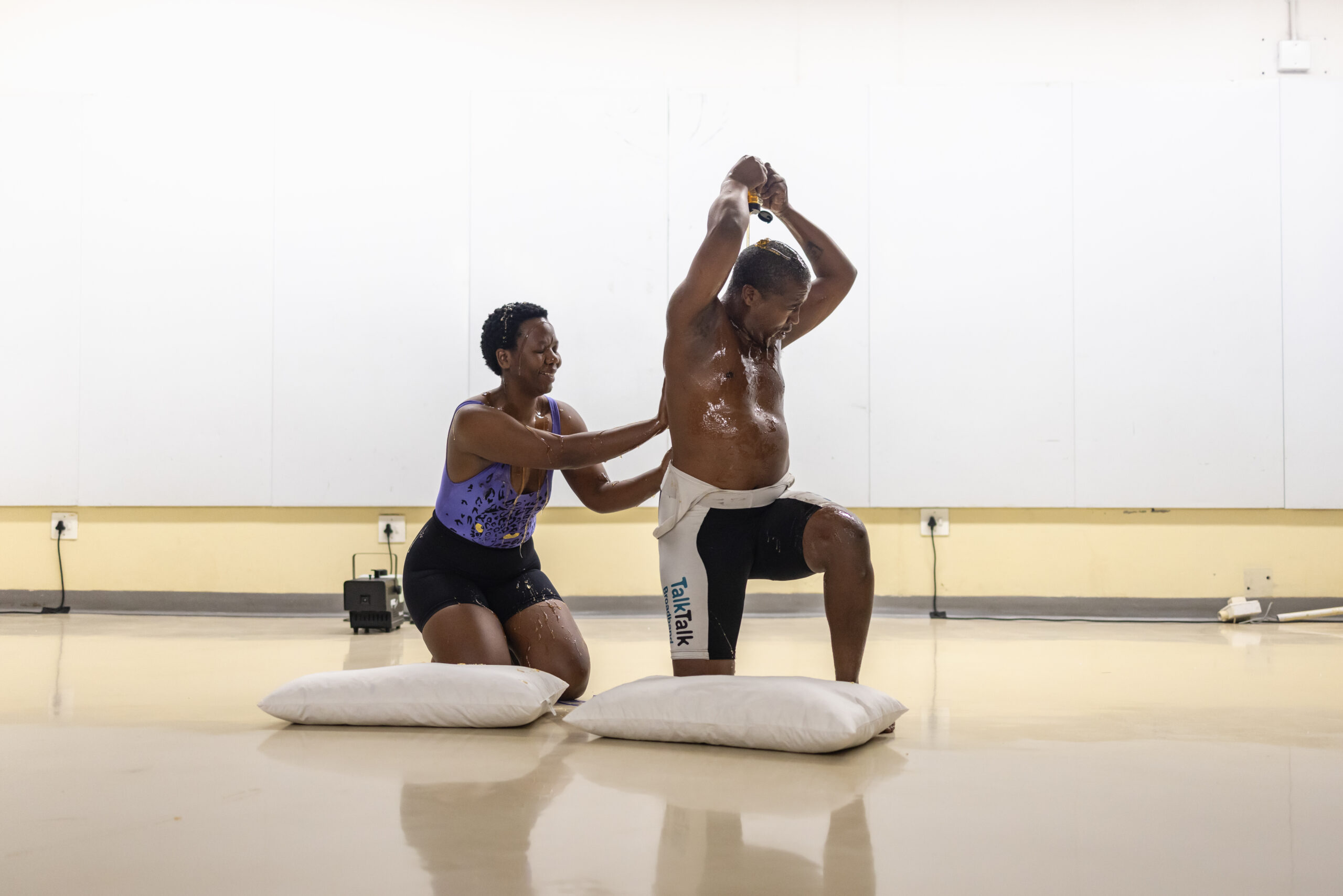
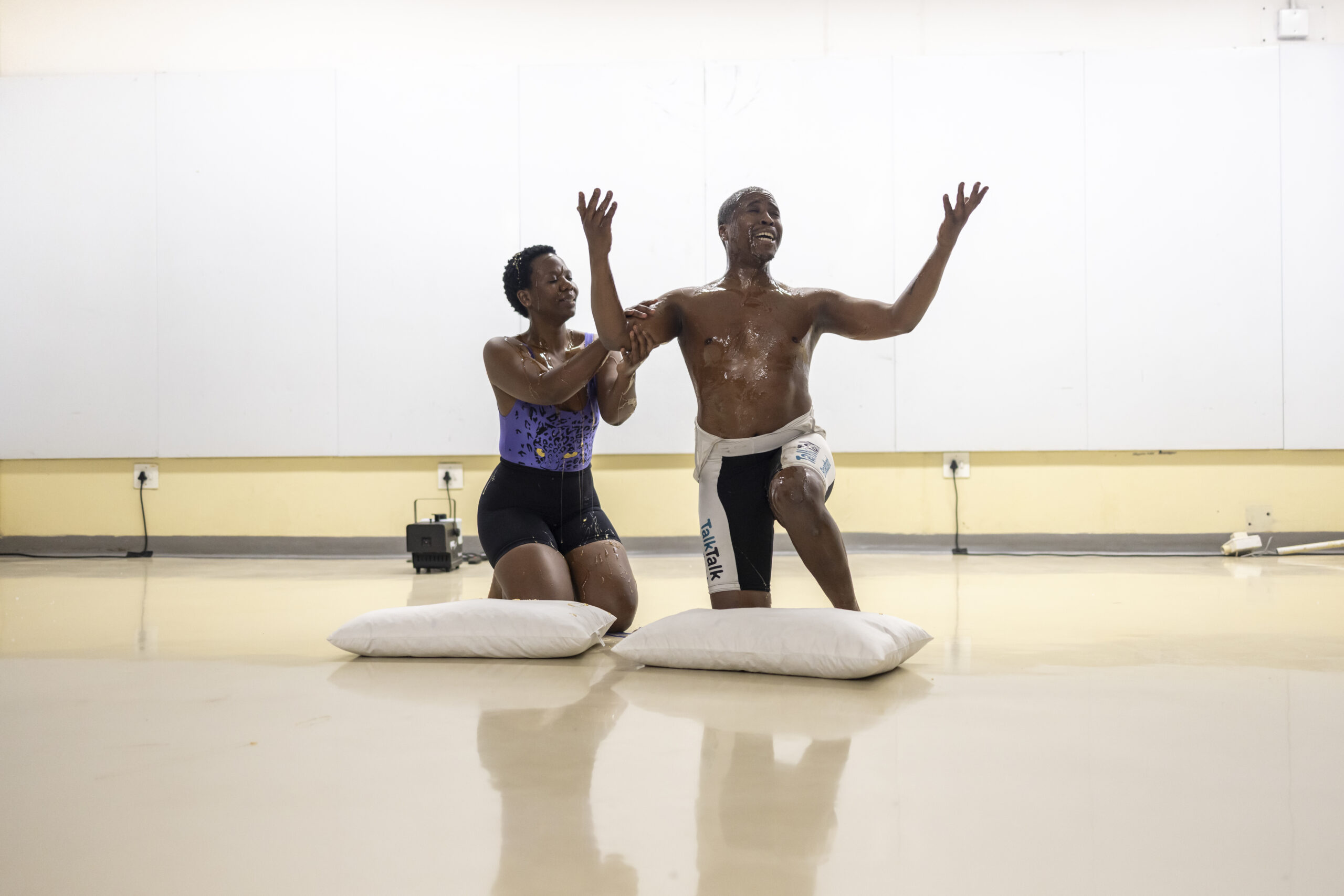
And those keen shafts of memory that stung like fire (2025) – Performance with honey and salt – Duration and dimensions variable – Courtesy of the artist – Photography by Anthea Pokroy
And those keen shafts of memory that stung like fire is the new performance work by Oupa Sibeko, conceptualized and performed in collaboration with Lerato Matolodi. The title references the text within Albert Camus’ 1947 novel The Plague. Here, Sibeko explores how memory and stories are carried, interrupted or rewoven through bodies – human and non-human, mythic, material and speculative. Storytelling becomes a porous, embodied process and, through these ephemeral gestures, the artist invites viewers to experience the world’s inherent fluidity, finding stability not in fixed answers, but in movement, breath and becoming. Much like a bee making honey, or the fluidity of the salty sea, this performance investigates the creation of spaces for encountering uncertainty, impermanence and transformation. Sibeko draws from his Nguni heritage and from experiences across cultures to examine curative and healing properties that navigate the confluence of art, science and Daoist philosophy. Via honey and sea salt – materials engaged as active collaborators – the performance reveals invisible connections between individual existence and cosmic cycles.










Sources
[1] Latitudes. [no date]. Oupa Sibeko. Available at: https://latitudes.online/artists/oupa_sibeko?srsltid=AfmBOooFjkrKrW8Sk8vFZ7ExgQdKsMOOKQYTIej_aQGVl-S1RJ60f8q8 [Accessed: 18 April 2025].
[2] Sassen, R. 2016. Interview with South African performance artist Oupa Sibeko. My View by Robyn Sassen and other writers. Available at: https://robynsassenmyview.com/2016/08/01/weighing-wanting-and-kneading/ [Accessed: 8 May 2025]. And SABC News. 2022. Oupa Sibeko’s new art work on display at NWU Gallery. Available at: https://www.youtube.com/watch?v=p0OfvctKgv0 [Accessed: 1 May 2025].
[3] Leipzig International Art Programme. 2024. LIA Portraits w/ Oupa Sibeko. Available at: http://youtube.com/watch?v=N4rD0qNEREY [Accessed: 1 May 2025].
[4] Sassen, R. 2016. Interview with South African performance artist Oupa Sibeko. My View by Robyn Sassen and other writers. Available at: https://robynsassenmyview.com/2016/08/01/weighing-wanting-and-kneading/ [Accessed: 8 May 2025].
[5] Manaleng, K. and art times. [no date]. AT FEATURE: Quality/Inequality exhibition curated by Oupa Sibeko at NWU Botanical Garden Gallery. Available at: https://arttimes.co.za/at-feature-quality-inequality-exhibition-curated-by-oupa-sibeko-at-nwu-botanical-garden-gallery/ [Accessed: 18 April 2025]. And Oupa Sibeko. [no date]. Available at: https://latitudes.online/artists/oupa_sibeko?srsltid=AfmBOooFjkrKrW8Sk8vFZ7ExgQdKsMOOKQYTIej_aQGVl-S1RJ60f8q8 [Accessed: 18 April 2025]
[6] Sassen, R. 2016. Interview with South African performance artist Oupa Sibeko. My View by Robyn Sassen and other writers. Available at: https://robynsassenmyview.com/2016/08/01/weighing-wanting-and-kneading/ [Accessed: 8 May 2025].
[7] Mail&Guardian. 2019. Oupa Sibeko. Available at: https://200youngsouthafricans.co.za/oupa-sibeko-arts-2019/ [Accessed: 1 May 2025].
[8] Shortlisted Artists 2020. [no date]. Available at: https://www.goethe.de/prj/hga/en/h20/shl.html [Accessed: 4 June 2025].
[9] ArtAfrica. 2021. Black is Blue: A durational performance artwork by Oupa Sibeko – ART AFRICA Magazine. Available at: https://artafricamagazine.org/black-is-blue-a-durational-performance-artwork-by-oupa-sibeko/ [Accessed: 24 April 2025].
[10] Oupa Sibeko. 2025. Available at: https://davidkrutprojects.com/artists/74557/oupa-sibeko [Accessed: 4 June 2025].
[11] Sibeko, O. 2021. Bottled Sea Water: A Sea Inland. University of the Witwatersrand. Available at: https://wiredspace.wits.ac.za/server/api/core/bitstreams/6fefcf69-8ca9-496d-bf27-fafc60bae568/content [Accessed: 8 May 2025].
[12] ArtAfrica. 2021. Black is Blue: A durational performance artwork by Oupa Sibeko – ART AFRICA Magazine. Available at: https://artafricamagazine.org/black-is-blue-a-durational-performance-artwork-by-oupa-sibeko/ [Accessed: 24 April 2025].
[13] Sibeko, O. 2021. Bottled Sea Water: A Sea Inland. University of the Witwatersrand. Available at: https://wiredspace.wits.ac.za/server/api/core/bitstreams/6fefcf69-8ca9-496d-bf27-fafc60bae568/content [Accessed: 8 May 2025].
[14] Akademie Schloss Solitude. 2023. Oupa Sibeko. Available at: https://www.akademie-solitude.de/en/person/oupa-sibeko/ [Accessed: 4 June 2025].
MEET THE ARTISTS