TAWANDA TAKURA
Biography
Challenging systems of oppression that silence resistance and maintain the status quo, Tawanda Takura’s sculptural works made of repurposed found objects critique the failures of the state leaders to lead their people and provide the basics needed for survival. In addition, Takura’s work challenges the roles of Christianity and how Christianity was imposed on people during colonialism and how Zimbabwe is continuing to grapple with its legacy of colonialism.[1]
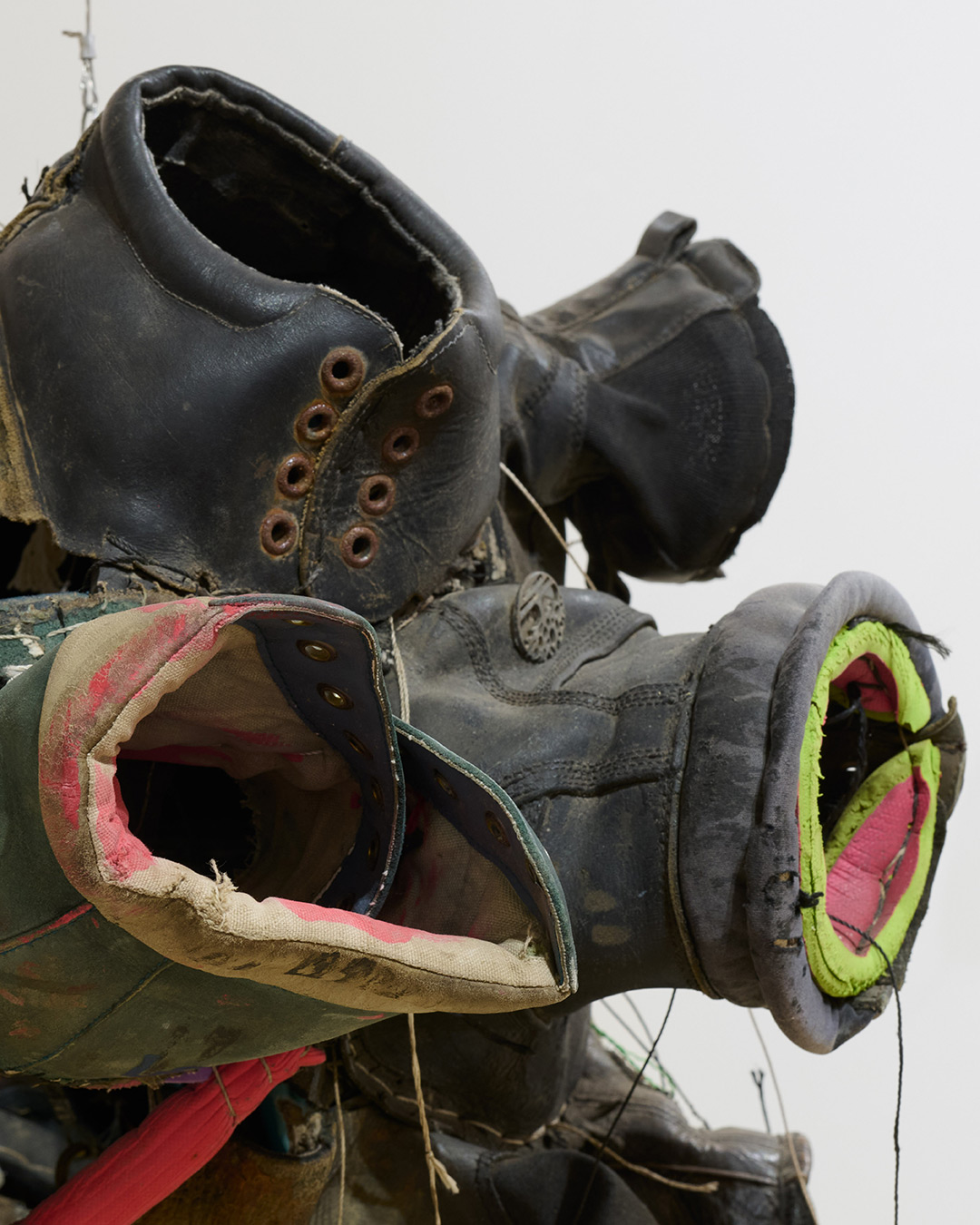
Born and raised in 1989 in Chitungwiza, Zimbabwe. He taught himself how to be a shoemaker and began making shoes for the retail market.[2] Struck by the amount of discarded shoes he began to find discarded in dumpsites, he started to wonder if he could reanimate them in different forms.[3] Using shoes he salvaged from around his community, which he believes are imbued with the identity of their previous owners and a history of their movements, Tawanda Takura began repurposing the shoes to make figures and other sculptural forms.[4] Shoes took on a particular significance for Takura, both professionally connected to his work and socially, connecting him to others, through their absence their discarded shoes allowed him to gain insight into who they were, where they walked, and what they used their shoes for. Using other found materials such as wire, wood, metal, and fabric, Takura’s work emphasises the cycles of power and oppression, by repurposing and reclaiming these materials into different forms, with more flexible items becoming symbolic for strength and flexibility.[5]
In 2012 Tawanda Takura began his art journey at Village Unhu Studios, practicing alongside artists like Gareth
Nyandoro, Portia Zvavahera and Misheck Masamvu, Tawanda Takura’s work began being included in exhibitions at Village Unhu from 2012 owards . Tawanda Takura’s work has been exhibited under Village Unhu at the Cape Town Art Fair in 2017 and 2018.[6] His work has also been included in group shows in Mauritius and Hong Kong.[7]
In 2019 Tawanda Takura exhibited in a group show at Guns & Rain Gallery in Johannesburg, South Africa and later in 2020, his work was exhibited under Guns & Rain at the Cape Town Investec Art Fair.[8] At the Cape Town Investec Art Fair, Takura exhibited a series of masks made from found materials. These masks, which took on animal-like masks explored the theme of ‘the animal within’, highlighting how abuses of power and leadership crises are making people hide their true selves and keeping themselves subdued to avoid confrontation.[9] Takura likens shoes to masks, allowing people the ability to move between different spaces, where their shoes do not reveal who they are, but rather let them fit in.[10]
In 2021, Tawanda Takura began a residency at Guns & Rain in Johannesburg, where he produced a body of work in collaboration with the NGO African Reclaimers Organisation, which works with waste reclaimers in Johannesburg. The body of work challenged consumerism which allows for so much waste that can be recycled and reused to be thrown away. In addition, the body of work asks that we consider what we consume, what we throw away and what that reveals of us. The exhibition presents several heads made of rubber soles of shoes, topped with other discarded shoes like high heels, football boots, worn out ballet slippers, as well as using lines of the Bible or the now-defunct Zimbabwean dollar, which are clear references to the rise of charismatic churches and socio-economic turmoil in Zimbabwe.[11] By working with the African Reclaimers organisation, Tawanda Takura got access to a range of materials from various parts of Johannesburg that he could use within his work, making them city-specific to Johannesburg yet thematically oriented towards Zimbabwe.
Within Takura’s work, a clear theme of challenging societal hierarchies, for illuminating colonial legacies, and questioning corruption and governance emerge. In recent years, he has begun experimenting more with collage painting introducing symbolic motifs which are part of his evolving language of critique.[12]
ln 2023 Tawanda Takura had his first solo exhibition at the National gallery of Zimbabwe tilted katundu katurikwa. In 2024, Tawanda Takura won the Cassirer Welz Award and following the award, in his first solo exhibition in South Africa, Rabbit hole runs deep, he lamented the unkept promises of post-independence Zimbabwe, which has been replaced with stagnation and corruption. The show, Rabbit hole runs deep, shares Takura’s reflections on social and political dynamics in Zimbabwe, highlighting the dualities experienced by people: disillusionment and hope; censorship and expression; memory and healing; and freedom and dependence.[13] Within the show, Takura uses the recurring object of the tongue of a shoe to represent the choir of silenced voices and the suppression of dissent.[14] Alongside these are hand-carved chess pieces which reflect his reading of politics as a realm where the powerful fight for power at the expense of the pawns who jettisoned off the board. These works highlight the inequality within society and the lack of freedom experienced by individuals and collectives. Tawanda Takura’s work raises urgent and important questions about the state, governance, and corruption within Zimbabwe. Using materials used and discarded by people, he connects his messages to a collective voice, urging seriousness in the subject matter even though the objects he uses have been found and collected from other’s waste. Takura’s socio-political commentaries highlight the fragility of freedoms, especially freedom of expression and freedom of speech in a country where these freedoms are continuously attacked and people are silenced.
While his work responds directly to Zimbabwe, the themes within his work are applicable around the world as authoritarianism rises, stripping many of their voice and entrenching social hierarchies that favour a few.

ARTIST STATEMENT
Chicara Addiction (2023); Old shoes, strings, cigarette stubs, wire; 90,2 x 30,2 x 40,7cm; Courtesy of the artist
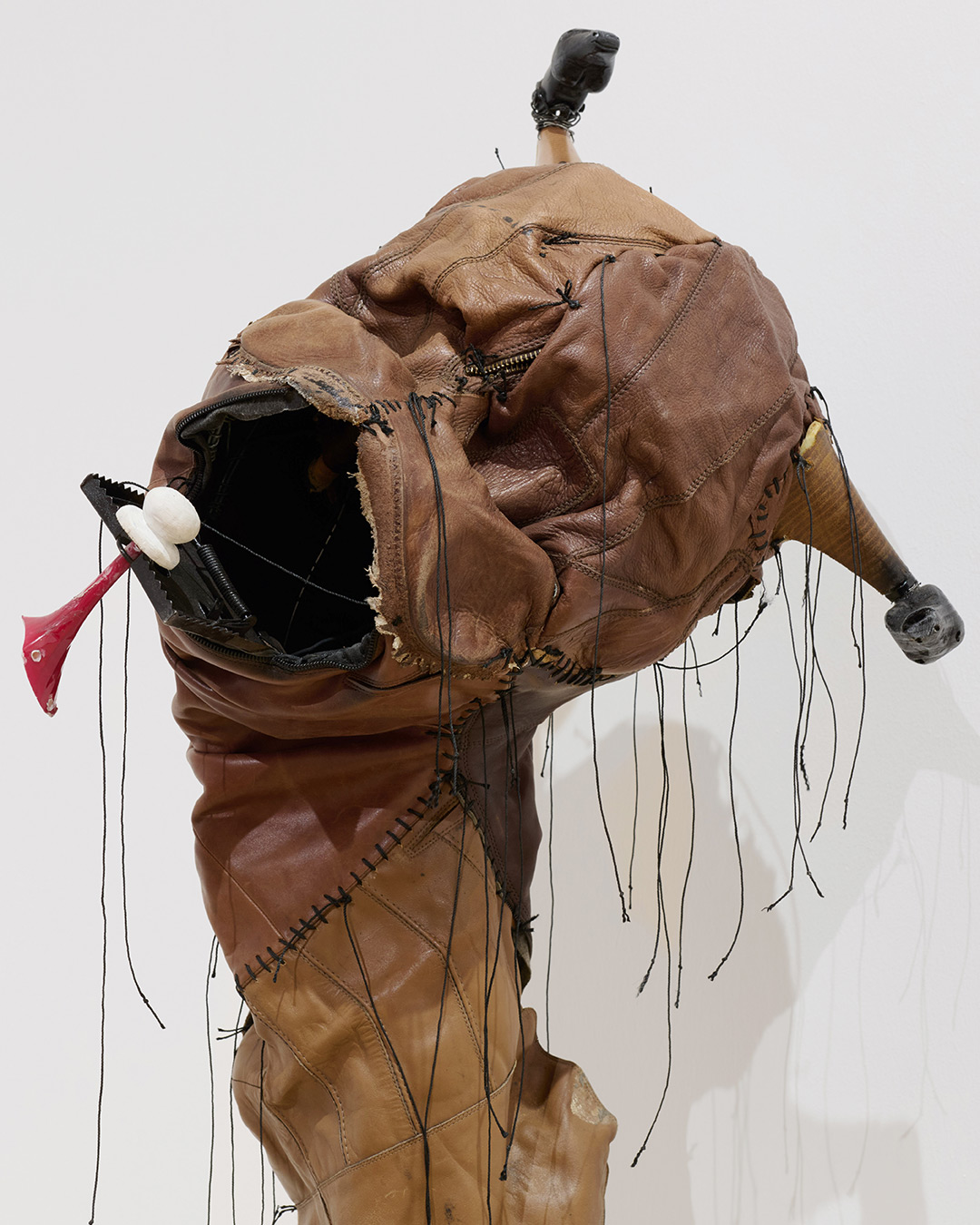
Macabre (2024): Old shoe upper leather and mixed media; 108 x 48 x 43 cm; Courtesy of the Bag Factory
Nhume dzemucheka l / Man of the cloth l (2020): Old shoe upper leather, string, wire, shoe lust; 82 x 32 x 51 cm; Private Collection
Nhume dzemucheka ll/ Man of the cloth ll (2020): Old shoe upper leather, string, wire, shoe lust; 75 x 39 x 47 cm, Private Collection
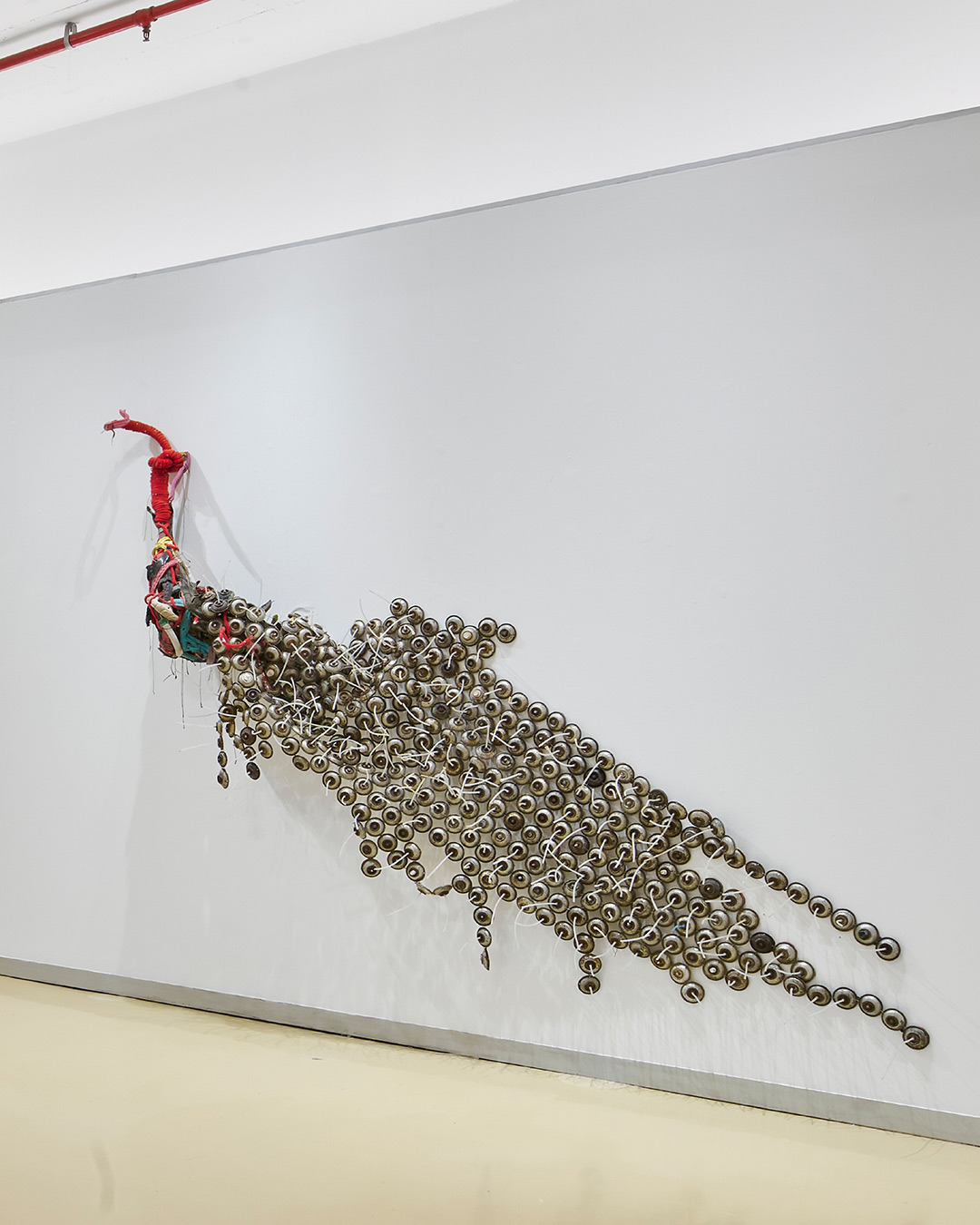
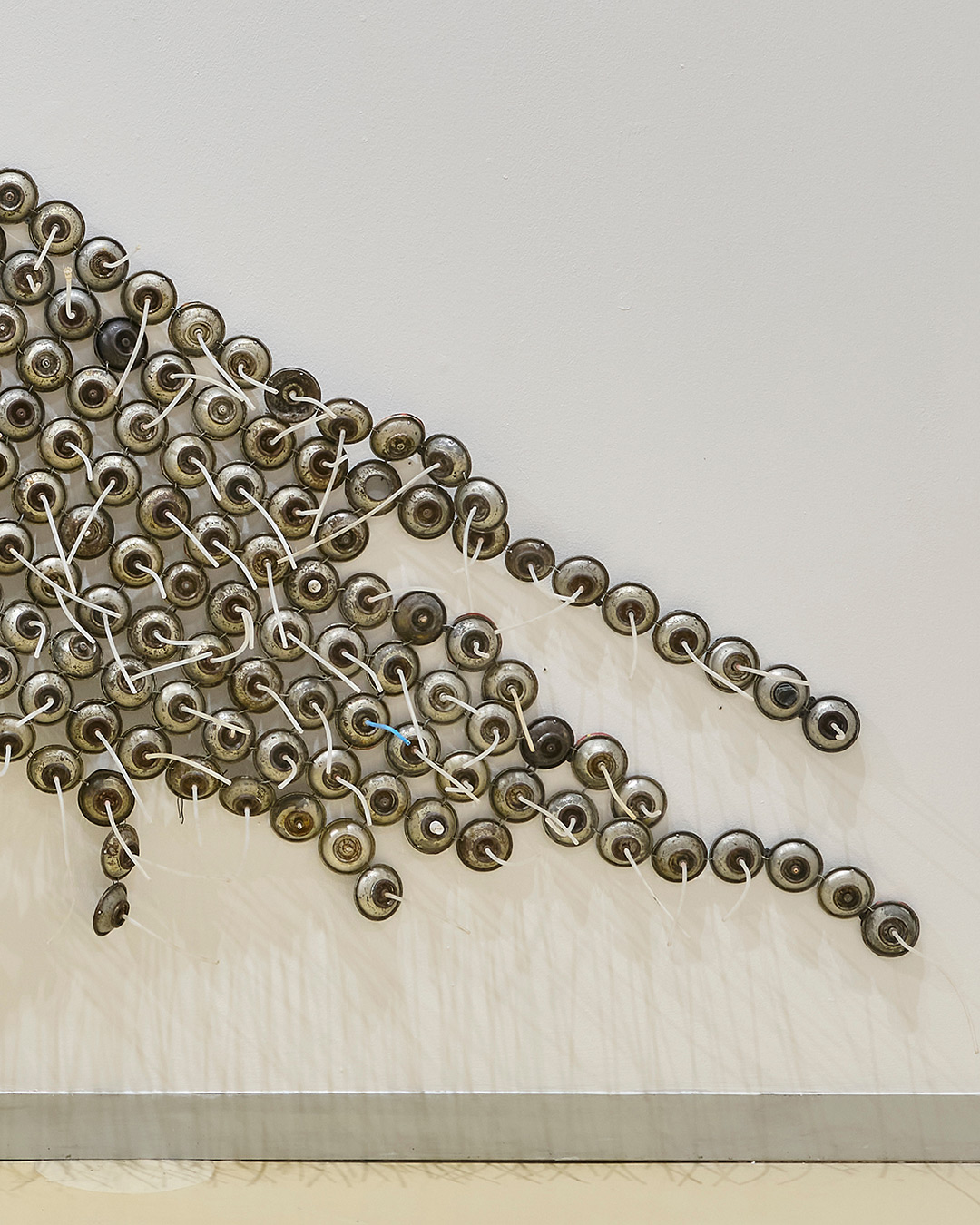
From rags to rags (2020): Old shoes, strings, perfume cans; 83 x 113 x 263 cm; Private Collection
During the process of finding these discarded shoes, l would go around the community and also commission waste reclaimers from around my community to salvage discarded old shoes from my neighbourhoods and dumpsites. The found shoes then go through a cleansing process, washing them with disinfectant detergents. This cleansing process is quite profound – it’s like a ritual or a prayer of the cleansing of the spirits and their detachment from the shoes. By chasing away their unwanted presence , the aura the owner carried doesn’t interfere with the creative process. Some old shoes are quite heavy to deal with – maybe someone lost their life in them – so l make sure that l preserve the aesthetics and the human adject of the shoe, and not overly destroy that character. These shoes are like vessels that document our movements every day.
l begin by disassembling the shoes, exposing the inner hidden layers that we don’t normally notice, even they play important roles in reinforcing and shaping the shoe. I then reassemble them, but in my own interpretation, carefully incorporating my creative process, intentionally – giving them a new lease of life.
My philosophy is that an old shoe is more important than a new one. A new one is quite an empty vessel with no identity, but an old shoe becomes important because it carries our biographies. Old shoes become an extension of ourselves since they absorb our DNA through sweating and skin exfoliation. It feels as though, when working with these shoes, it’s like dealing with the present–absent body of whoever owned them. The residue becomes the extension of the owner who now lives on through the shoes. So if only we knew the importance of the old shoes, we would keep our old shoes in vaults because they have all our secrets.
I am inspired by my community, my environment, my people and their everyday life. There are these interesting collages of events that transpire in my community, so l borrow heavily on the socio-political and religious scenarios within the community, and the most reccurring subjects reflects issues of identity and spirituality. Sometimes l assume the role of a spectator watching from a distance, and sometimes narrative events – personal stories – happen to me.
The type of shoes l select are based on aesthetics, which is really important because it tells time and status, whether it was worn over periods of years, and the kind of life they lived – comfortable or struggling. Colour selection is like mimicking the idea of a painting in my sculptures, and quality of a shoe material shows whether the material is durable, and not get destroyed easily. The shape of a shoe l find interesting because sometimes that speaks to me and inspires ideas of its own. So when work with these found objects, l get to attentively approach the work and leave room for the work to speak on its own and not to impose all my ideas. It’s like push and pull, finding a sweet spot for the work.
The choices of material l use is symbolic and purposely placed in the creative process of making the work. When I am using the shoe tongues, that resembles the use of our speech – what we say, how we say it, the power of the spoken word etc. Stiletto heels signify the femininity and also sometimes pain, depending on the narrative am drawn to. Shoe soles signify the soul of a person. If they are soles from men’s shoes, men they become a point of manhood. Using shoe laces and strings is like healing by stitching things together.






Sources
[1] The Bag Factory. 2024. Exhibition by Tawanda Takura . Available at: https://www.bagfactoryart.org.za/exhibitionby-tawanda-takura/ [Accessed: 2 June 2025].
[2] Goethe. 2024. Tawanda Takura, Zimbabwe . Available at: https://www.goethe.de/prj/hga/en/a21/sl2/taw.html [Accessed: 2 June 2025].
[3] SAFFCA. [no date]. Tawanda Philimon Takura – SAFFCA . Available at: https://saffca.com/artistcv/tawandaphilimon-takura/ [Accessed: 2 June 2025].
[4] Goethe. 2024. Tawanda Takura, Zimbabwe . Available at: https://www.goethe.de/prj/hga/en/a21/sl2/taw.html [Accessed: 2 June 2025].
[5] The Bag Factory. 2024. Exhibition by Tawanda Takura . Available at: https://www.bagfactoryart.org.za/exhibitionby-tawanda-takura/ [Accessed: 2 June 2025] and SAFFCA. [no date]. Tawanda Philimon Takura – SAFFCA . Available at: https://saffca.com/artistcv/tawanda-philimon-takura/ [Accessed: 2 June 2025].
[6] Contemporary&. 2024. Tawanda Takura Wins 13th Cassirer Welz Award . Available at: https://contemporaryand.com/magazines/tawanda-takura-wins-13th-cassirer-welz-award/ [Accessed: 2 June 2025]
[7] Tsumele, E. 2021. Tawanda Takura transforming the work of reclaimers into powerful visual language commenting on politics and religion – CityLife Arts . Available at: https://citylifearts.co.za/tawanda-takura-transforming-the-workof-reclaimers-into-powerful-visual-language-commenting-on-politics-and-religion/ [Accessed: 2 June 2025].
[8] Guns & Rain. 2020. Tawanda Takura . Available at: https://chromeextension:// efaidnbmnnnibpcajpcglclefindmkaj/https://gunsandrain.com/wp-content/uploads/2020/02/ICTAF-2020-Tawanda-Takura-Catalogue-14-Feb-1.pdf [Accessed: 2 June 2025].
[9] Guns & Rain. 2020. Tawanda Takura . Available at: https://chromeextension://
efaidnbmnnnibpcajpcglclefindmkaj/https://gunsandrain.com/wp-content/uploads/2020/02/ICTAF-2020-Tawanda-Takura-Catalogue-14-Feb-1.pdf [Accessed: 2 June 2025].
[10] Guns & Rain. 2020. Tawanda Takura . Available at: https://chromeextension://efaidnbmnnnibpcajpcglclefindmkaj/https://gunsandrain.com/wp-content/uploads/2020/02/ICTAF-2020-Tawanda-Takura-Catalogue-14-Feb-1.pdf [Accessed: 2 June 2025].
[11] Tsumele, E. 2021. Tawanda Takura transforming the work of reclaimers into powerful visual language commenting on politics and religion – CityLife Arts . Available at: https://citylifearts.co.za/tawanda-takuratransforming-the-work-of-reclaimers-into-powerful-visual-language-commenting-on-politics-and-religion/[Accessed: 2 June 2025].
[12] The Bag Factory. 2024. Exhibition by Tawanda Takura . Available at: https://www.bagfactoryart.org.za/exhibitionby-tawanda-takura/ [Accessed: 2 June 2025].
[13] The Bag Fatory. 2024. Exhibition by Tawanda Takura . Available at: https://www.bagfactoryart.org.za/exhibitionby-tawanda-takura/ [Accessed: 2 June 2025].
[14] The Bag Fatory. 2024. Exhibition by Tawanda Takura . Available at: https://www.bagfactoryart.org.za/exhibitionby-tawanda-takura/ [Accessed: 2 June 2025].
MEET THE ARTISTS