

The Imagined New Volume I:
Working through Alternative Archives | Art, History, Africa and the African Diaspora
ORGANISED BY VIAD
FACULTY OF ART, DESIGN AND ARCHITECTURE, UNIVERSITY OF JOHANNESBURG, 17 BUNTING ROAD, AUCKLAND PARK, JOHANNESBURG
10 – 12 May 2019
Volume I was inflected by the Black Radical Imagination implied in the overarching idea of the Imagined New. The Imagined New project started taking shape through a three-day workshop held at the University of Johannesburg on 10-12 May 2019. The workshop was titled ‘Working through Alternative Archives | Art, History, Africa and the African Diaspora’. The interdisciplinary gathering included curated conversations, artistic performances, and panel discussions geared toward fostering a critical exchange of ideas among South African, continental African, and African diasporic scholars, curators, and artists.
Key points of discussion centered around Black memory (as performing archives of the Imagined New); enactments of refusal (as creative strategies for living otherwise); and the necessary rethinking of African and African diasporic sacral art practices.
The programme was convened by Anthony Bogues, the Director of the Ruth Simmons Centre for the Study of Slavery and Justice, Brown University, also currently a Distinguished Visiting Professor in VIAD. Bogues introduced the workshop by stating the following:
“Conceiving this gathering was about trying to create a generative space, central to which is what I would like to think about as a certain ‘practice of voice’. This involves a set of practices through which voices can be heard and listened to – enabling a certain collectivity of thinking around different often disparate strands and tributaries, as ways of trying to think about Black life.”
Anthony Bogues | Workshop rationale and objectives


At the Imagined New (or, what happens when History is a Catastrophe?) Vol 1: In ‘Working through Alternative Archives | Art, History, Africa and the African Diaspora’ workshop, the “new” was considered within the context of the Black Radical Tradition where futures were shown to be continuous with the catastrophic past. The “new” was envisioned as possibly located at the intersection between past, present and future Black life.
The questions raised at the workshop are seen as critical nodes in furthering the work of worldbuilding.
The multimodal programme was collectively facilitated by Surafel Wondimu Abebe, Geri Augusto, Tina Campt, Khwezi Gule, Saidiya Hartman and Alberta Whittle. The brief framing statements of the sessions each facilitated are shown below:
LIVING HISTORIES
“It is to history that we owe our frames of reference, our identities and our expressions… I myself carry the sense of this destruction within me for a long time… – James Baldwin”
We can see how history comes as a catastrophe, but that catastrophe did not just happen in the past, but has been lingering, not in empty time, as Walter Benjamin says, but within us, in our bodies. So, how can we think of embodied historiography, or what Diana Taylor calls ‘repertoire’?”
Surafel Wondimu Abebe | LIVING HISTORIES. Black memory as performing archives of the Imagined New

REFUSAL
“How do we think about black life from the perspective of South Africa and the historical catastrophes that have shaped black life here – not just in terms of forces that have seen its domination (in the history of Black life), but also in the ways that Black life has regenerated itself, through the practices of refusal, resistance, radical imagination and creative agency?”
Tina Campt | REFUSAL. Black precarity, and creative strategies for Living Otherwise

THE EVERYDAY
“I implore us to think about the translocality of sacral arts. What I want to suggest is that we can’t really think in new insurgent or transgressive ways about the sacral arts we have in mind by thinking of indigenous African religions as somehow disconnected or walled off from indigenous African knowledges. They are intertwined, and you are doing deep epistemic damage if you try to cherry-pick them out, or by interpreting sacral arts without any grounding – if not in the languages then at least in the discourses and the narratives in which they have been created, whether in Africa or the diaspora.”
Geri Augusto | THE EVERYDAY AND ITS OTHER FUTURES. Rethinking African/Diasporic sacral art practices

MUSEUMS
“What is interesting for me about state-owned art galleries and museums in South Africa is that they don’t seem to form part of the post-apartheid imaginary … several things have been overlooked and these include issues of social justice, economic justice and racial justice. I think that these things – that are excluded or suppressed – could offer a different way in which to imagine museums in the historical sense, or in the realm of the visual arts.”
Khwezi Gule | MUSEUMS FOR WHOM? MUSEUMS FOR WHAT?
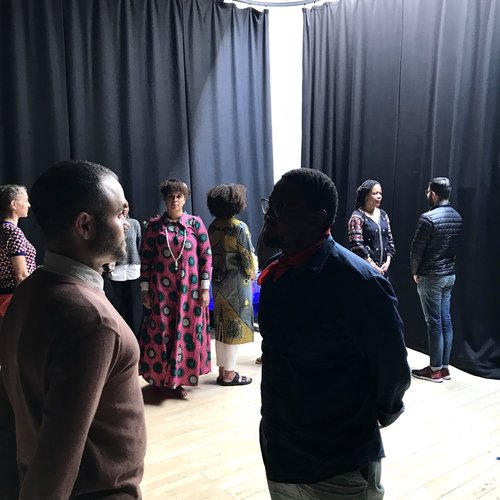
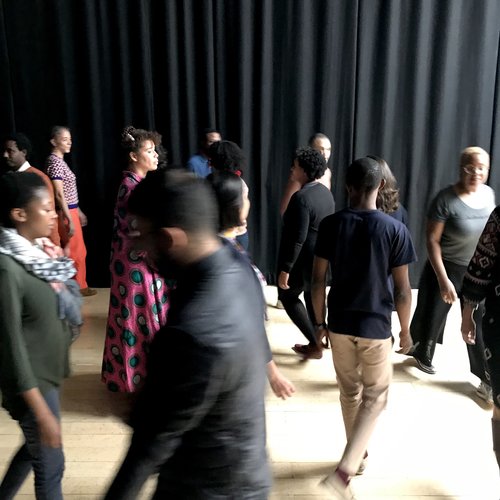
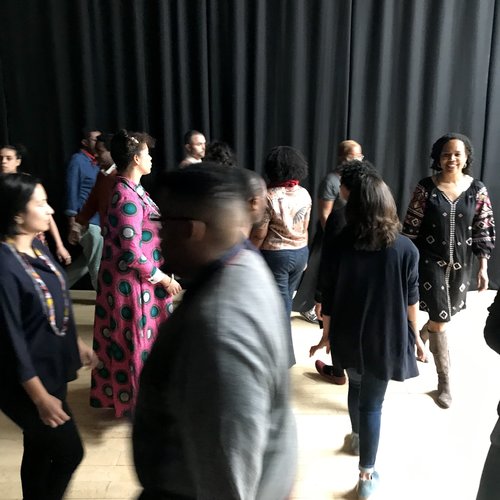
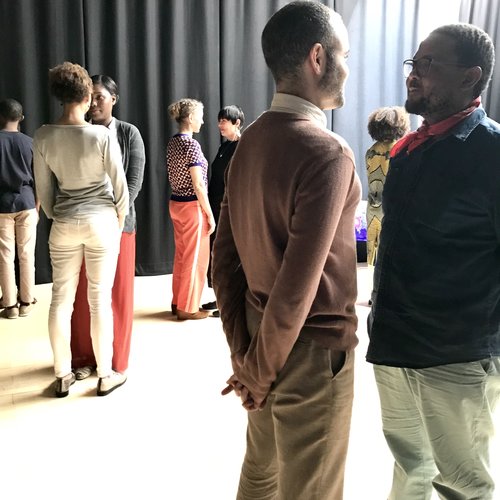

Alberta Whittle, Sorry not sorry at the Imagined New Volume 1: Working through Alternative Archives | Art, History, Africa and the African Diaspora, performance documentation, UJ Arts & Culture, 2019
Participants included: Surafel Wudime Abebe, Geri Augusto, Anthony Bogues, Tina Campt, Nicola Cloete, Felicia Denaud, Leora Farber, Cheryl Finley, Maiyah Gamble-Rivers, Gabrielle Goliath, Thembinkosi Goniwe, Khwezi Gule, Keitu Gwangwa, Keval Harie, Saidiya Hartman, Russel Hlongwane, Nomvuyo Horwitz, Erica Moiah James, Saarah Jappie, Nikita Keogotsitse, Sharlene Khan, Thomas J. Lax, James Macdonald, Ingrid Masondo, Thabang Monoa,Thato Mogotsi, Farieda Nazier, Zamansele Nsele, Cláudia Rocha, João Roxo, Amie Soudien, Huda Tayob, Deborah Thomas, Alberta Whittle & Nelisiwe Xaba.
Proposed in the conversations, interventions, performances, incantations and, yes, meals eaten together was a radical rethinking of the archive – or rather, of alternative archives, in relation to Art, History & the African Diaspora.