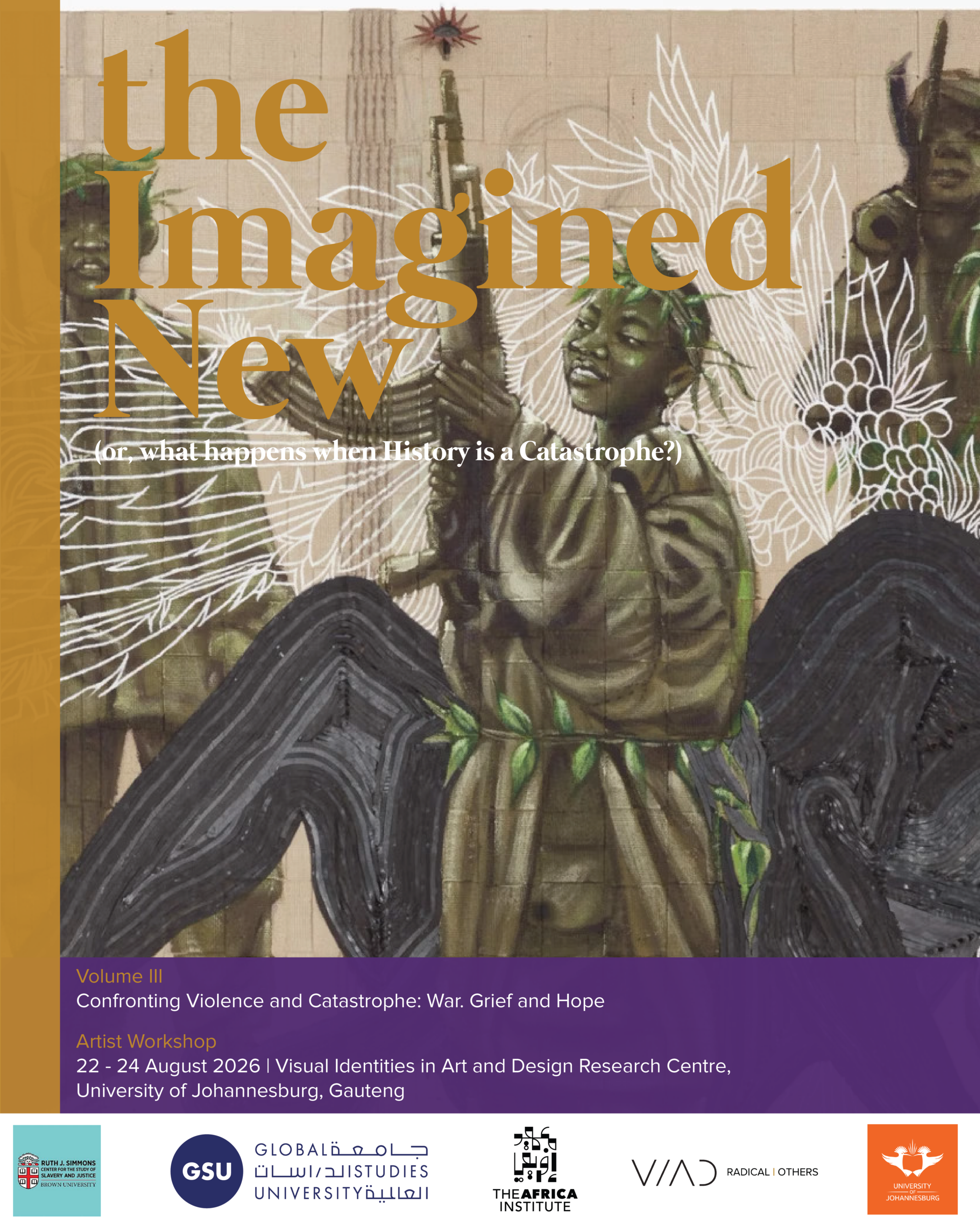
the Imagined New (or, what happens when History is a Catastrophe?)
HOSTED BY VIAD
Since 10 May 2019 – ongoing.
The Imagined New (or, what happens when History is a Catastrophe?) is an interdisciplinary platform for exchange and research on critical thought and creative practices, dealing with issues of historical and contemporary violence and catastrophe. Working from the critical framework of Black Radical Thought, the Imagined New explores creative practices in relation to questions of history, archive and alternative imagination.
The long-term project is a collaboration between the Visual Identities in Art and Design Research Centre, University of Johannesburg and the Ruth J. Simmons Center for the Study of Slavery and Justice, Brown University with a network of global partners. In its third iteration, the project includes collaboration with The Africa Institute, Global Studies University. The Imagined New was conceived to fulfil three initial aims:
i.) to collaboratively explore alternative archives and pursue these creative possibilities in the political work of the Black Radical Tradition
ii.) to create a space in which African and African diasporic creative practices can visualise, move, embody, perform, sound and interface with radical claims to black life and
iii.) to engage with theories on Blackness that challenge notions of determinism which socially construct people of colour with limitations in their creative and intellectual activities.
“How do we engender a polyvocal, nuanced, elastic language of Blackness? What might its grammars be? Is it fungibility? Disposability? Precarity? How do we think of Blackness as generative, as wavered, as fractal? What would this arsenal or treasure trove of concepts, forms, assemblages and modes of practice look like? How do we nurture these radical imaginaries?”
Saidiya Hartman | Closing reflections
VOLUME I
Volume I was inflected by the Black Radical imagination implied in the overarching idea of the Imagined New. The Imagined New project started taking shape through a three-day workshop held at the University of Johannesburg on 10-12 May 2019. The workshop was titled ‘Working through Alternative Archives | Art, History, Africa and the African Diaspora’. The interdisciplinary gathering included curated conversations, artistic performances, and panel discussions geared toward fostering a critical exchange of ideas among South African, continental African, and African diasporic scholars, curators, and artists.
Key points of discussion centered around Black memory (as performing archives of the Imagined New); enactments of refusal (as creative strategies for living otherwise); and the necessary rethinking of African and African diasporic sacral art practices.
The programme was convened by Anthony Bogues, the Director of the Ruth Simmons Centre for the Study of Slavery and Justice, Brown University, also currently a Distinguished Visiting Professor in VIAD. Bogues introduced the workshop by stating the following:
“Conceiving this gathering was about trying to create a generative space, central to which is what I would like to think about as a certain ‘practice of voice’. This involves a set of practices through which voices can be heard and listened to – enabling a certain collectivity of thinking around different often disparate strands and tributaries, as ways of trying to think about Black life.”
Anthony Bogues | Workshop rationale and objectives


VOLUME II
Volume II paid particular attention to sonic creations as an alternate realm for Black life to enact freedom. In Volume II of the Imagined New notions of heritage and heresy were turned toward one other, rather than in opposition. Black Radical Traditions were understood as theories of practice attuned to the work of collective listening and the ‘Black Sonic: Heritage as Heresy’ was developed as an exploratory programme. The digital archive ‘Black Sonic: Heritage as Heresy’ launched in December 2022 as a haptic, loosely structured and interdisciplinary sonic experiment.
Originally planned as an in-person workshop to take place at Brown University, Providence, USA in 2020 the second volume was reconfigured due to COVID-19 lockdowns. The initially intended physical gathering – a movement of peoples in space to the free-form rhythms of ‘castaway’ Black cultural practices – became a digital archive of ongoing experimentation from Black Radical Imagination, within sonic forms.

VOLUME III
Volume III extended the initial aims of the Imagined New to a framing under the thematic of ‘Confronting Violence and Catastrophe: War, Grief and Hope’. The theme followed the unspeakable violences unfolding across the globe, from 2024 and ongoing.
As an ongoing iteration of the project, Volume III highlights current ways in which contemporary settler colonialism and manifestations of authoritarianisms – as forms of rule – create death worlds. This contemporary moment in the histories of violence is one where human life can only be told through ‘tales of death’. In Palestine, Sudan, Haiti, the Democratic Republic of Congo and Ethiopia, violence, sometimes framed by war, has become an everyday occurrence, such that human life often becomes superfluous. How do humans live in such contexts? Indeed, the Imagined New Volume III asks what does it mean to be human in contexts where war and violence are not instruments of power but in their practices become power themselves?